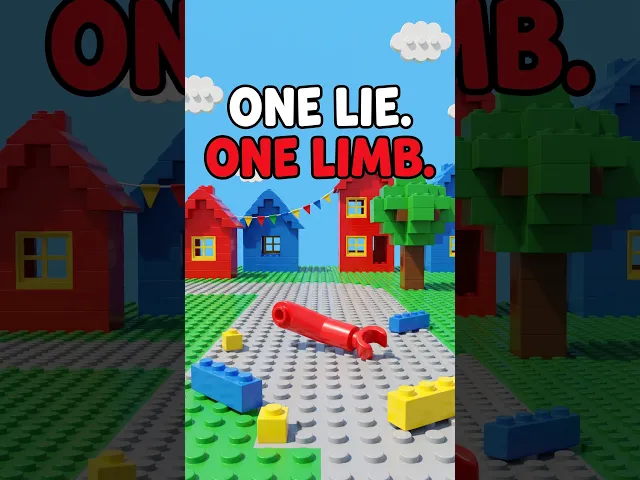

In this town, every time you lie, a brick falls off your body. The used car salesman is a pile. The mayor is a head on a skateboard. And Benny, who has never told a lie, is about to be asked whether he likes Grandma's meatloaf.
"Every Lie Costs You a Brick" is a 30-second, 19-scene vertical short made in a single Claude conversation. The Atlabs MCP gave Claude a narrator and a soundtrack without anyone leaving the chat: one tool call for the voiceover, one for the music. Claude wrote the script, built the brick world in code, and cut the picture to the voice. Here is exactly how it was made, with the full script, the real prompts, and every scene.
"Every Lie Costs You a Brick" at a glance
Runtime: 0:30
Scenes: 19, across 21 cuts
Characters: 6 (the liar, the fisherman, the salesman, the mayor, Benny, Grandma) plus a crowd of five
Locations: 5 (the street, the used car lot, town hall, Benny's house, the kitchen)
Key prop: one grey, lumpy meatloaf
Voice: one narrator, the "Hey Its Brad" voice, generated through the Atlabs MCP
Music: a 30-second instrumental comedy underscore, generated through the Atlabs MCP
Script: 88 words
Format: 9:16, 1080 x 1920, 30 fps, English, one-word captions
What the Atlabs MCP is
The Atlabs MCP is a connector that puts Atlabs inside an AI assistant such as Claude. Once it is connected, Claude can call Atlabs tools directly from the conversation, so you ask for a voiceover or a soundtrack in plain words and the finished file comes back in the same chat.
For this short we used four of its tools:
list_voices to browse narrator voices by language, gender and description
generate_voice to turn the script into a narration file
generate_music to write the soundtrack from a text description
get_result to collect each finished file
The same connector also exposes Atlabs image generation, video generation, upscaling, lip sync and the full story workflows. We did not need them here because the visuals in this short were built in code, which we explain below.
Why "In this town" shorts work
Before writing anything, Claude studied three blocky-character "In this town" story shorts frame by frame. Two of them had passed 2 million and 3.7 million views when we looked. They share a formula:
One absurd rule, stated in the first three seconds. "In this town, secrets turn into mice." The viewer knows the game at once.
Three or four fast examples. Each one is a single joke and a single shot.
One named character. The story narrows to a person the rule is about to hurt.
A twist in the last line. The ending makes people replay the short.
A cut every 1.3 to 1.6 seconds. We counted 18 to 22 cuts in the first 30 seconds of each reference.
Narration at 160 to 190 words per minute, with no pauses.
One-word captions in bold white with a black outline, with the key word in colour.
We kept that grammar and wrote a new story for it, with new characters and a brick-built look.
How to make a brick-style story short with Claude and the Atlabs MCP, step by step
Connect the Atlabs MCP to Claude. Add the connector once and its tools show up in every conversation.
Give Claude your references and the brief. We pasted three YouTube Shorts links and asked for a similar 30-second video in a brick style, with the full script first.
Approve the script. Claude returned an 88-word script and a shot list with camera moves, transitions and sound effects for each scene.
Generate the music. Claude called generate_music with a written description and a 30-second length.
Generate the voiceover. Claude called list_voices, picked a young storyteller voice, and called generate_voice with the script.
Fit the voice to 30 seconds. The first take ran 38 seconds, so Claude trimmed the pauses and sped it up 1.2 times to finish at 28.4 seconds.
Build the scenes. Claude wrote the sets, the characters and the camera for every shot in Three.js, and placed every cut on the narrator's words.
Add captions and sound effects. One-word captions pop in with a CSS animation, and 39 sound effects sit on the cuts and the pops.
Render and export. 900 frames, 1080 x 1920, ready to upload as a Short.
The inputs behind this short
Here is everything that went in. Nothing below is tidied up after the fact.
Project settings
References: three "In this town" YouTube Shorts
Length: 30 seconds
Aspect ratio: 9:16, for Shorts
Language: English
Style: brick-built characters and sets
Voice: "Hey Its Brad", an ElevenLabs voice inside Atlabs
Music model: ElevenLabs Music inside Atlabs, 30 seconds, instrumental
The script
This is the script exactly as it was sent to generate_voice.
The music prompt
This is the prompt exactly as it was sent to generate_music, with the length set to 30 seconds and instrumental turned on. It returned a bouncy pizzicato track that ends on a short sting.
The style: a toy-brick world built in code
The look is a toy-brick town: studded baseplates, stacked brick houses with stepped roofs, glossy plastic, hard sunlight, and stiff little figures with printed faces.
What makes it work for this story:
Parts that come off. Every figure is built from separate pieces: head, torso, two arms, two legs and a hat. When a character lies, a piece flies off on a small arc, lands, and stays where it fell for the rest of the film.
Printed faces that swap. Each expression is a small drawing on the head: smug, shocked, nervous, a clenched fake grin. A face change on a cut does the acting.
Flat, bright colour. Red, yellow, blue and green against a clean sky keep every shot readable in under two seconds.
A camera that never rests. Push-ins, a top-down tilt, one orbit, snap zooms with a small shake on every pop, and a whip-pan for the reveal.
We built this look in Three.js instead of generating it, because the joke depends on exact timing: an arm has to leave the body on the word "Pop". Code gave us frame-level control over that. Atlabs carried the two things code cannot write, a human-sounding narrator and an original score.
Meet the cast
Each character was built once and reused in every scene, so Benny's green shirt and blue overalls never change between shots.
The liar

Red shirt, white collar, red tie, and a black brick for a hat. He opens the film by claiming to be six feet tall.
The fisherman

Yellow raincoat, yellow hat, and a very small fish. His catch was this big.
The used car salesman

A heap of grey bricks with a grin, a gold tooth and a red tie somewhere in the middle.
The mayor

A top hat, a monocle, a moustache, and nothing below the neck. He travels by skateboard.
Benny

Green shirt, blue overalls, brown hair, every brick still attached.
Grandma

Grey bun, round glasses, purple cardigan, pearls, and a meatloaf she is very proud of.
"Every Lie Costs You a Brick", scene by scene
Nineteen scenes across four acts. The narrator carries every one, and each cut lands on the first word of its line.
Act 1: The rule
Scene 1: In this town

Narrator: "In this town,"
The camera starts straight above a brick street and tilts up to the town in under a second. A whoosh starts the music.
Scene 2: The lie
Narrator: "every time you lie,"
A figure raises one hand above his head. His speech bubble reads "I'm 6 feet tall!"
Scene 3: The hat goes

Narrator: "a brick falls off your body."
His hat brick pops off with a white flash, the camera snaps in, and his face changes to shock.
Scene 4: One stud

Narrator: "Tiny lie? One stud."
A ground-level shot by his feet. A single red stud drops, bounces twice and rolls.
Act 2: The town
Scene 5: The one that got away
Narrator: "Big lie? Your whole arm."
The fisherman holds his arms wide under a bubble that reads "It was this big!"

On "whole", one arm drops off. The camera tilts down to follow it and he stares after it.
Scene 6: The salesman
Narrator: "The used car salesman is just a pile."
A push-in across the car lot to a heap of grey bricks. One last brick lands on top and the pile wobbles.
Scene 7: The mayor
Narrator: "The mayor is a head on a skateboard."
The camera pans with a head in a top hat as it rolls past the crowd and stops at the podium.
Act 3: Benny
Scene 8: Then there's Benny

Narrator: "Then there's Benny."
A low-angle hero shot. The door swings open, Benny hops out, and sparkles burst around him.
Scene 9: Never told a lie
Narrator: "Benny has never told a lie."
The camera orbits him in a quarter circle, hands on hips.
Scene 10: Not one brick missing


Narrator: "Not one brick missing."
Three punch-in close-ups in a second and a half: arm, leg, head. Each one gets a green tick and a rising bell.
Act 4: The meatloaf
Scene 11: Grandma serves

Narrator: "Until Grandma asked,"
Grandma slams the plate down in front of Benny. The music scratches to a halt and his smile goes flat.
Scene 12: The meatloaf

Narrator: "Do you like my meatloaf?"
A low close-up puts the meatloaf in the foreground with Grandma beaming behind it.
Scene 13: Benny sweats

Narrator: "Benny said,"
An extreme close-up. His eyes dart left and right and one drop of sweat slides down his head. The music drops to a murmur.
Scene 14: "It's delicious"

Narrator: "It's delicious."
He forces a grin and raises an arm.

Narrator: "Pop! There goes his arm."
On "Pop", the arm leaves his shoulder and lands on the meatloaf. The camera snaps in on the plate.
Scene 15: Both legs

Narrator: "Best I've ever had."
His last arm gives a shaky thumbs up.

Narrator: "Both legs."
Both legs shoot out sideways and he drops until only his head shows above the table.
Scene 16: Grandma smiles
Narrator: "Grandma smiled. Thanks. I made it myself."
A slow push-in on Grandma. On "Thanks", the music cuts out completely.
Scene 17: Her head falls off

Narrator: "Her head fell off."
In silence, her head pops off, lands on the table and rolls toward the plate. Benny watches it go.
Scene 18: Store-bought

Narrator: "It was"
A close-up of the head lying on its side, still smiling.

Narrator: "store-bought."
The camera whips to the bin. A red box reads "Meatloaf $3.99". A boom lands on the reveal and the music comes back.
Scene 19: The aftermath

No narration. One last wide shot: Benny's head, his arm on the meatloaf, Grandma's head on the table, and her body still standing with its hands on its hips.
Finishing the short: voice, music and timing
Picture was the last thing we locked. The order that worked was voice first, then picture, then sound.
Voice first. The narration from the Atlabs MCP ran 38 seconds on the first take. Claude found each line by its pauses, cut the gaps down, and sped the read up 1.2 times so the last word lands at 28.4 seconds. Every cut in the film is placed 0.06 seconds before the first word of its line, so the picture always arrives just ahead of the voice.
Music as a character. The Atlabs track plays under the first half at low volume, ducks when Benny starts to sweat, cuts to silence when Grandma says "Thanks", and returns on the reveal. That silence does more for the last two jokes than any sound effect.
Sound effects on the cuts. 39 hits in 30 seconds: whooshes on the cuts, pops on every lost part, three rising bells on the ticks, a record scratch on the meatloaf, a boom on the box.
Ready to publish?
Upload the 9:16 file as a YouTube Short with the rule in the title: "In this town, every lie costs you a brick."
Pin a comment that asks viewers for the next rule. The format is built for sequels.
Keep the cast. Benny and Grandma can return next week with a new rule and the same voice.
Frequently asked questions
What is the Atlabs MCP?
It is a connector that gives an AI assistant such as Claude direct access to Atlabs tools. In this project Claude used it to browse voices, generate the narration, generate the music and collect the finished files, all inside one conversation.
Was this whole short made inside Atlabs?
No. The voiceover and the music came from Atlabs through the MCP. The brick world, the camera moves, the captions and the edit were written as code by Claude, and the sound effects came from a sound library. We split it that way because the jokes needed frame-level timing.
Can I make the visuals in Atlabs too?
Yes. The same connector exposes Atlabs image generation, video generation and the story workflows, including a cartoon story workflow that designs a cast once and reuses it in every scene. We did not use them for this short, so this post does not show their output.
Which voice and music model did you use?
The narrator is the "Hey Its Brad" voice, picked from the Atlabs voice list. The soundtrack came from the ElevenLabs Music model in Atlabs, set to 30 seconds and instrumental.
How long should an "In this town" short be?
The references we studied run 80 to 170 seconds, and the hook, the rule and three examples all fit inside the first 30. Our short tells a complete story in 30 seconds with 88 words.
Do I need to know how to code?
Not for the voice and the music. You describe what you want and the Atlabs MCP returns the files. The visuals in this short were written by Claude, and we only described the scenes and approved the script.
Make your own story short
"Every Lie Costs You a Brick" started as three reference links and one sentence. Claude wrote the script and built the town, and the Atlabs MCP supplied the narrator and the score from inside the same chat. Your first rule can start the same way: pick the absurd rule, approve the script, and ask for the voice.