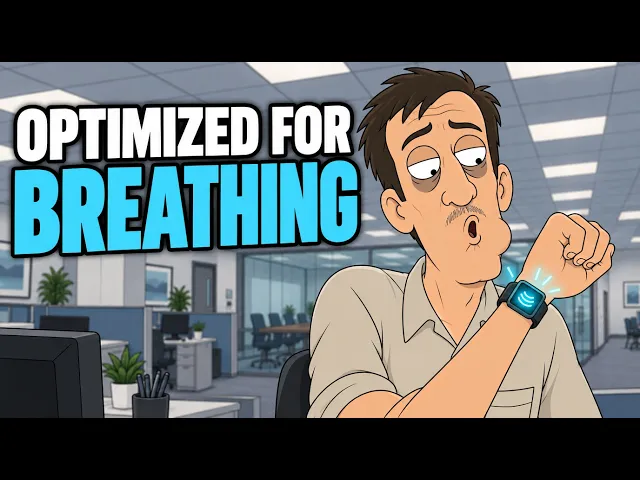
Gary's smartwatch tells him when to breathe. His calendar tells him when to have ideas. Today's idea is scheduled for 3:15, and at 3:15 it gets moved to the third quarter.
Optimized for Breathing is a 50-second office satire made start to finish in Atlabs in the American Comics style. Gary and his boss Denise look identical in all 9 scenes, from the first desk shot to the final pigeon. Here is how it was made, with every input we used.
Optimized for Breathing at a glance
Runtime: 0:50
Scenes: 9, each one a joke about modern office life
Characters: 2 (Gary the over-optimized employee, Denise the always-smiling boss)
Locations: 2 (an open-plan office with its conference and break rooms, a city street at dusk)
Voice: One deadpan narrator
Music: An upbeat track, played completely straight
Style: American Comics, with bold ink outlines and flat, punchy color
Format: 16:9, English, fully animated
Why do AI cartoons lose their characters, and how do you fix it?
The biggest problem with most AI cartoons is drift. When every clip is generated on its own, the hero's face changes shape, their shirt changes color, and the art style wobbles from one shot to the next. Viewers notice straight away, and the story falls apart.
Consistent AI animation comes down to five things:
Design each character once, before animating. Atlabs creates a character sheet for every character from your script, then uses it as the reference in every scene.
Give every location a reference too. The office, the break room and the street keep the same layout and lighting each time they appear.
Lock one style for the whole film. You choose the style once, and every scene is drawn in it.
Plan the whole story at once. Atlabs turns the full script into scenes in order, so each shot knows who is in it and what came before.
Fix one scene without redoing the rest. If a shot is off, change just that scene with the AI editor. Everything else stays exactly as it was.
The same approach works for long films. The Star That Led Home, another film made in Atlabs, keeps its three characters consistent across 39 scenes and almost four minutes.
Why do satire cartoons work so well online?
A satirical cartoon uses exaggeration and irony to poke fun at something everyone recognizes. The internet's favorite animated satire, from office humor to life-admin jokes, tends to follow the same simple formula, and Optimized for Breathing uses all of it:
A relatable target. Productivity culture, wellness apps, "we're a family" bosses. Everyone who has worked in an office has met them.
A deadpan narrator. The voice never jokes. It describes absurd things in the tone of a corporate training video, and that contrast does the work.
The rule of three, with a twist. "Mandatory fun is held every Wednesday. Attendance is optional. Attendance is tracked." Set up, set up, sting.
One sad, lovable hero. Gary barely moves or speaks, so the audience projects themselves onto him.
A tiny, human ending. No big moral. Gary just looks at a pigeon doing nothing, and almost smiles.
Short satire like this is made to be shared. It's quick to watch, instantly relatable, and people tag their coworkers in it. It also used to need an animator, a voice actor and an editor. In Atlabs, one person writes the script and the platform handles the rest: character designs, every animated scene, the narrator's voice, music and the final edit, all in one place.
How to make a cartoon animation with AI in Atlabs, step by step
Write your script. Any story works. Keep one line or beat per scene. Optimized for Breathing is six short script beats.
Start a new animated video. Open the Atlabs animated video maker, paste your script, and choose the language, frame size and scene pace.
Choose one style for the whole film. We used American Comics, one of 50+ styles in Atlabs.
Review your cast. Atlabs designs each character and location first. Adjust a look once and the change carries through every scene.
Let Atlabs animate the film. It animates every scene with your characters, and adds the narration and music.
Fix single scenes with the AI editor. Change a line, an image or an animation in one scene without regenerating the others.
Export and share. Post the full film on YouTube or LinkedIn, or make a vertical version for Reels, Shorts and TikTok.
The inputs behind this film
Here is everything we gave Atlabs to make Optimized for Breathing. Atlabs did the rest: characters, locations, props, every scene, voices and music.
Project settings
Script: A full screenplay, shown in full below
Language: English
Aspect ratio: 16:9 (landscape, for YouTube)
Scene pace: Fast
Style: American Comics
Video model: Automatic
Image model: Automatic
Resolution: Automatic
The input script
This is the script exactly as it was pasted into Atlabs. It's written in plain English: who the characters are, what happens in each scene, and what the narrator says.
The style: American Comics, the look of internet satire
Optimized for Breathing uses the American Comics style in Atlabs. It's the look of the satirical cartoons you scroll past every day: bold black ink outlines, flat punchy colors, exaggerated faces and simple, readable backgrounds. It suits satire for three reasons:
Faces sell the joke. Gary's dead-tired eyes and Denise's unnervingly wide smile read instantly, even on a phone screen.
Flat, clean backgrounds. Identical desks, a beanbag nobody uses, a sad Wellness Wednesday cake. Simple shapes make every visual gag easy to spot.
It feels like a comic strip come to life. That familiar comic-strip look tells the audience "this is satire" before the narrator says a word.
American Comics is one of more than 50 animation styles in Atlabs. Others that work well for satire and comedy:
Adult Satire Flat: grown-up sitcom-style satire
90s Grunge Cartoon: gross-out, retro TV comedy
Mid-Century Modern Cartoon: dry, design-forward humor
Retro Saturday Cartoon: classic TV slapstick
Stickman Doodle: fast, low-fi explainer jokes
Corporate Memphis: parodying corporate explainer videos
Meet the cast: characters and locations that stay the same in every scene
Atlabs designed both characters from the script and kept them identical in every scene, so Gary's beige shirt and hollow stare and Denise's sharp bob and giant smile never drift.
Gary

A tall, thin office worker in his 40s with a faint mustache, a beige shirt, a smartwatch and dead-tired eyes. He has been optimized.
Denise

The boss: sharp bob, tailored blazer and an unnervingly wide smile. Believes the company is a family.
The locations
Open-Plan Corporate Office

A vast, sterile office floor under cold fluorescent light, with Gary's desk, a glass-walled conference room and the break room.
City Street

A busy downtown sidewalk at dusk, cool blue light mixed with amber shop windows.
Optimized for Breathing, scene by scene
Nine scenes, nine jokes. Here is each one, with the line it carries and the gag it lands.
Act 1: Meet Gary
Scene 1: Gary has been optimized
Narrator: "This is Gary. Gary has been optimized."
A long row of identical desks, and Gary staring at his monitor with dead eyes. The deadpan opening line sets the tone for everything.
Scene 2: Breathe on command

Narrator: "His watch tells him when to breathe. His calendar tells him when to have ideas."
His smartwatch buzzes and Gary takes a slow breath on command, under sticky notes that say Synergy, Hustle and Breathe.
Scene 3: The scheduled idea

Narrator: "Today's idea is scheduled for 3:15."
Even creativity has a calendar slot. The line plants the setup that pays off in scene 7.
Act 2: The company is a family
Scene 4: A family that tracks keystrokes

Narrator: "The company is a family. A family that tracks your keystrokes."
Denise beams at a slide with a rising arrow. Everyone claps in sync, and Gary claps half a second late.
Scene 5: Mandatory fun

Narrator: "Mandatory fun is held every Wednesday. Attendance is optional."
The break room: a sad cake that reads Wellness Wednesday and a beanbag chair no one has ever sat in.
Scene 6: Attendance is tracked

Narrator: "Attendance is tracked."
Gary eats a single grape. Three words land the rule-of-three punchline.
Act 3: The idea that never happened
Scene 7: Rescheduled to Q3

Narrator: "At 3:15, Gary almost had an idea. Then it was moved to the third quarter."
The clock hits 3:15, Gary's eyes widen, he opens his mouth, and the calendar pings: idea rescheduled to Q3. The setup from scene 3 pays off.
Scene 8: Never been more productive
Narrator: "Gary is very productive. Gary has never been more productive."
Gary walks home through the city at dusk among identical commuters, every one of them staring at a phone.
Scene 9: Gary would like to be a pigeon

Narrator: "Gary would like to be a pigeon."
Gary looks up at a pigeon doing absolutely nothing, and almost smiles. The quietest joke in the film is also the warmest.
Finishing the film with the Atlabs AI editor
Once the film is made, you don't start over to fix something. The AI editor works one scene at a time: you ask for the change, and only that scene updates. Everything else stays exactly as it was.
Change a line. Tighten a narrator line so the joke lands faster.
Change an image. Redo one shot while the characters keep their look.
Change an animation. Redo the motion in a single scene without touching the others.
Make a vertical version. Turn the finished film into a cut for Reels, Shorts and TikTok.
Frequently asked questions
How do I make a cartoon animation with AI?
Write a short script, paste it into an AI animation tool such as Atlabs, and choose an art style. Atlabs designs the characters and locations, animates each scene, adds narration and music, and lets you change any scene with its AI editor before you export.
How do I keep characters consistent in AI animation?
Use a tool that designs each character once and reuses that design in every scene, instead of generating each clip from scratch. Atlabs creates a character sheet for every character before animating and keeps one style for the whole film, so faces, outfits and colors stay the same.
Can I make a long cartoon with AI?
Yes. Atlabs makes multi-scene films with the same characters throughout. The Star That Led Home, made in Atlabs, runs almost four minutes across 39 scenes.
How do I make a satirical cartoon with AI?
Write a short script where a calm narrator describes something absurd as if it were normal, one line per scene. Paste it into Atlabs, choose a bold comic style such as American Comics, and Atlabs designs the characters, animates each scene, and adds narration and music. Then tighten any scene with the AI editor and export.
What makes a cartoon satirical?
Satire exaggerates something real to point out how ridiculous it is. In Optimized for Breathing, a smartwatch that tells you when to breathe and an idea rescheduled to Q3 are only slight exaggerations of real office life, which is why they're funny.
What is the American Comics animation style?
It's a bold comic look with thick black ink outlines, flat bright colors and expressive, exaggerated faces, the style of many satirical cartoons online. It's one of more than 50 styles in Atlabs.
How long should a satire cartoon be?
Short works best. Optimized for Breathing tells a full story with a setup, escalating jokes and a payoff in under a minute, which suits YouTube, LinkedIn and short-form social video. If your story needs longer, Atlabs can make longer films with the same characters.
Do I need animation or voice acting skills?
No. You write the script. Atlabs handles the character design, animation, narration and music, and you make changes by asking the AI editor.
Can I use AI satire cartoons for marketing?
Yes. Brands use short satirical cartoons on LinkedIn, YouTube and Instagram because relatable humor gets shared. Keep the target a shared experience, not a real person or company.
Make your next satire cartoon with AI
Optimized for Breathing started as six short script beats about a man whose calendar schedules his ideas. Atlabs turned it into a fully animated satire with consistent characters, a deadpan narrator and music, all in one place. Your workplace has jokes in it too.