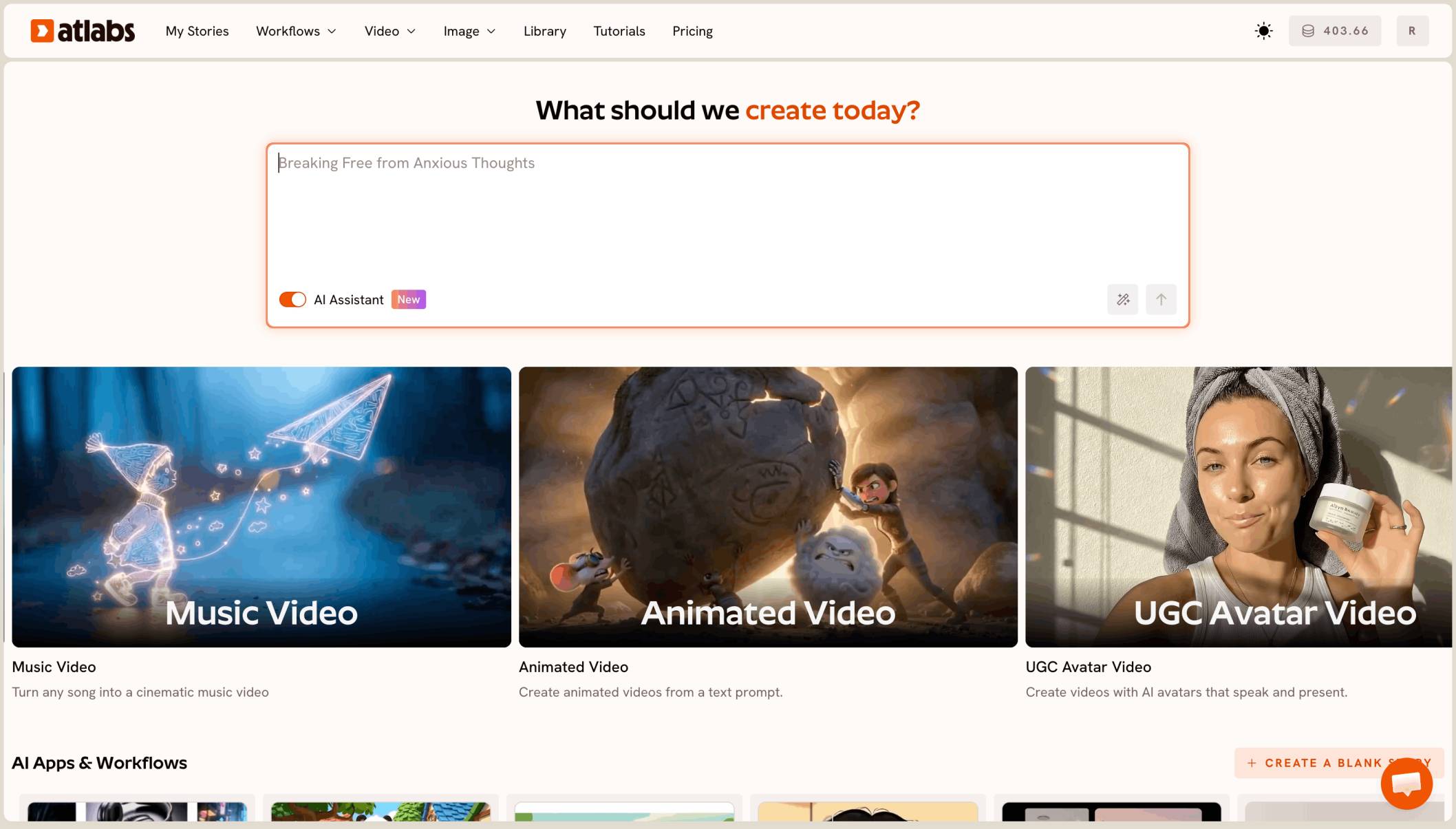
The best AI tool for legal explainer videos in 2026 is Atlabs, because legal content is written before it is visual and Atlabs is the only tool on this list that carries an approved script all the way to a finished narrated video with the same visual system across every practice area, then lets you fix a single scene when a rule changes instead of rebuilding the video.
Legal explainers have a constraint that marketing explainers do not. Everything on screen has to survive review. A sentence that overpromises an outcome, a fact pattern that resembles a real client, an unlabelled piece of attorney advertising, a jurisdiction stated too broadly. Any of these turns a finished video into a problem, and the tool you pick decides whether fixing it costs twenty minutes or a re-render.
So the comparison below is not about which tool makes the prettiest video. It is about which one fits a workflow where a reviewer has to sign off before anything publishes, and where the content changes when the law does.
What Actually Matters in a Legal Explainer Tool
Script first, not prompt first. Your explainer starts as reviewed text. A tool that begins with a script rather than a creative prompt keeps the reviewed words as the source of truth instead of asking you to translate them into a visual brief and hope nothing shifts.
Review before render. The cheapest place to catch a compliance problem is a 200 word document. Any workflow where the first reviewable artefact is a finished video has put the review in the wrong place.
Scene level editing. Rules change, thresholds move, a state updates a filing deadline. You need to change one scene.
Character and style consistency. A firm publishing across family law, immigration, employment and estates needs those to look like one firm, not four vendors.
Narration, captions and languages included. Client education content is watched on phones with the sound off, and by people whose first language is not the one you drafted in. Captions and translation are part of the deliverable, not extras.
No fabricated people. Legal advertising rules are strict about testimonials and about anything that reads as a real client or a real lawyer making a claim. A tool that makes it easy to generate a convincing fake person is a liability in this category, not a feature.
1. Atlabs: Best for a Full Practice Area Series with Review Built In

Best for: Law firms, in-house legal teams and legal aid organisations producing a library of client education or policy explainers that has to stay accurate.
Atlabs is a script to video workflow. You paste the approved script, choose an animation style, cast a narrator and any recurring characters, and it generates the complete narrated video with cuts, captions and motion graphics already applied. Nothing is assembled afterwards.
For legal work the sequencing is the point. Your reviewer sees the script before anything is generated, which is where legal review belongs. After render, scene level editing means a note from compliance touches one scene and one re-approval rather than the whole video.
The second thing that matters is consistency across a series. The Consistent Cast system locks your narrator, characters and recurring objects once, so the eight videos covering your practice areas read as one firm's voice. For legal aid and in-house teams the same mechanic keeps a policy series coherent across a dozen topics.
Animation also solves a problem specific to this category. Because the explainer is illustrated rather than acted, you are not putting a photoreal person on screen who could be mistaken for a real client, a real lawyer, or a testimonial. The visual carries the explanation without implying a person made a claim.
Key features
Step one, add your script. Paste the approved text, or draft with the built in AI Script Writer and route that draft through review before you generate. The working length is 150 to 220 words for a 60 to 90 second explainer (20mins animation in one go), structured as situation, how it works, then what to do next. A language selector sets the output language.
Step two, set your style. More than 30 animation styles plus 16:9, 9:16 and 1:1 aspect ratios, with a custom style option if the series has to match firm branding. For legal content the restrained styles hold up better across a long series. Corporate vector reads as credible for rights and process content. Whiteboard doodle works well for anything with steps, like a filing timeline or a claims process.

Step three, finalise your cast. Pick a narrator with a country accent suited to the audience, add characters, and lock recurring objects such as a document, a courthouse or a form so they appear identically across the series. Keep characters generic. Do not build a character that resembles a named attorney or a real client.
Step four, finalise and edit at the scene level. The video renders in one pass, then you review scene by scene. Verify every number, deadline and jurisdiction statement against the source here, and regenerate individual scenes as notes come back.
Step five, publish everywhere with the Global Release Kit, which translates the finished explainer into more than 40 languages, reframes it for other platforms and generates a thumbnail. For legal aid and immigration adjacent client education this is the difference between serving one language community and serving several.
Under the hood Atlabs routes between current video models including Seedance 2.0, Hailuo 2.3, Google Veo 3.1 and Kling 3.0.
Pricing
Pricing starts free, with paid plans from $15 per month. Trustpilot rating: 4.5/5. The free plan is enough to build one explainer and put it through your firm's review process before anyone approves a spend.
Verdict
The strongest fit if your legal video is a programme rather than a one off, and if a reviewer has to sign off before publication. It is the only tool here where script, animation, consistency, captions, scene level correction and translation are all in the same place.
2. Synthesia: Best for Presenter Led Policy and Compliance Modules
Best for: In-house legal and compliance teams delivering policy training through an LMS.
Synthesia is built around a photoreal presenter delivering a script, and it does that very well across a wide range of languages. For internal compliance training, where the format is genuinely a person explaining a policy and the delivery is through a learning system, it is a natural fit. Enterprise tiers add SCORM export, SSO and brand kits, which is why it appears in so many corporate compliance stacks.
Two cautions specific to legal use. The format is presenter led, so an explainer that needs to show a process, a timeline or a scenario is working against the tool. And any use of a custom avatar built from a real person's likeness deserves a considered decision, because a video fronted by a lawyer who later leaves the firm is a video you have to remake, and a likeness used in client facing marketing brings its own review questions.
Key features
Large stock avatar library, custom avatars from recorded footage, very wide language and voice coverage, SCORM export and SSO on enterprise tiers, API access on higher plans.
Pricing
Pricing runs from a limited free plan to roughly $29 per month for Starter and $89 per month for Creator, with custom enterprise pricing above that. Video minutes on the lower tiers are an annual allowance, so factor iteration into the estimate.
Verdict
A solid choice for internal policy training delivered through an LMS. Less suited to client facing explainers that need illustration rather than a presenter.
Compare It Against a Free Animated Explainer
3. Runway: Best for Firms With a Creative Team and a Distinct Look
Best for: Larger firms or agencies with an editor on staff who want to author the visual identity of a campaign.
Runway offers the widest creative range here. Broad model access, strong image and video generation, upscaling, custom voices for lip sync. If a legal campaign is a brand exercise as much as an educational one, and you have someone who can direct it, Runway gives you the most control over how it looks.
The catch for legal specifically is that everything after generation happens outside the tool. Script, narration, sequencing, captions, and crucially the version control that lets you prove which cut was approved, all live in your editor's project file. That is workable with a disciplined team and painful without one.
Key features
Current model family, high resolution upscaling, custom voices for lip sync on higher tiers, large asset storage, credit rollover at the top tier.
Pricing
Runway starts with free credits and a low cost entry tier around $15 per month, with higher tiers and custom enterprise pricing above that.
Verdict
Right when authorship matters and you own the editing step. Wrong when a two person marketing team needs eight explainers this quarter.
4. Kling: Best for Grounded Scenario Footage Inside a Larger Piece
Best for: Teams who need realistic footage to illustrate a situation, with another tool doing the explaining.
Kling produces convincing motion and human movement in short clips. For a legal explainer that benefits from a grounded moment, a workplace situation, a road incident, a signing at a desk, it supplies footage that would otherwise mean a shoot.
Use it carefully in this category. Realistic footage of people in legal scenarios sits close to the line where a viewer might read the depiction as a real case or a real client. Keep scenarios generic, keep them clearly illustrative, and keep them away from anything that resembles a specific matter.
Key features
Strong realism at short lengths, a solid image to video path, and a free tier generous enough to evaluate properly.
Pricing
Kling offers free daily credits and a low cost entry tier, with mid and upper tiers above that. Credit allowances reset monthly and change often.
Verdict
A useful ingredient for scenario shots. Not a legal explainer tool on its own.
Build the Whole Explainer in One Place Instead
5. Higgsfield: Best for the Brand Film Around the Explainer
Best for: Firm marketing teams making short, cinematic brand pieces rather than instructional content.
Higgsfield is built for cinematic motion and camera control, and short clips from it look genuinely filmic. For a firm brand film, a recruiting piece, or the ten second opening that sets up a client education series, it produces work that looks well beyond the effort involved.
For the explainer itself the limitation is structural. It generates clips, not narrated multi scene sequences, so the script, the voice, the structure and the assembly all happen elsewhere. Credits also expire monthly without rollover, which suits steady production more than the bursty rhythm of legal marketing.
Key features
Preset camera and motion controls, a strong image to video pipeline, high polish at short lengths.
Pricing
Pricing starts around $15 per month on annual billing and rises through mid and top tiers, though plans and credit allocations change frequently.
Verdict
Strong for the brand film. Not the tool for the explainer.
Watch the Full Atlabs Explainer Video Tutorial
If you want to see the script to finished video workflow before you draft a legal explainer, the full Atlabs tutorial walks through it end to end: pasting the script, choosing the style, casting the narrator, generating, and editing at the scene level.
Watch it here: https://www.youtube.com/watch?v=oQl2myIzXUQ
Swap the demo script for your approved copy and the process is identical.
Watch the Tutorial, Then Build Yours Free
How the 5 Tools Rank for Legal Explainer Videos
Scored across the six criteria at the top of this guide, script first input, review before render, scene level editing, consistency across a series, narration and captions and languages included, and no assembly required, out of 50:
Atlabs lands first at 48, because it is the only tool that answers all six rather than excelling at one. Synthesia takes second at 37, strong on narration, captions, languages and LMS delivery, weaker on illustrated formats and on anything where a photoreal presenter raises questions of its own. Runway follows at 32, the highest ceiling on look, the lowest score on removing production and version control work. Kling sits at 30 and Higgsfield at 29, both excellent at what they do and both dependent on other tools to become an explainer.
Keeping the Review Loop Intact
Whichever tool you choose, the workflow around it matters more in this category than the tool itself.
Review at the script stage and record it. The script is the artefact your reviewer should approve, because it is the cheapest thing to change and the clearest thing to evidence. Keep the approved version, and keep a note of who approved it and when.
Keep the facts generic. Client education explainers should describe how something works, not what happened to someone. Composite fact patterns that closely track a real matter are a confidentiality problem regardless of how the video was made.
Avoid outcome language. "You may be entitled to" and "this is how the process works" survive review in a way that "we will get you" does not. Nothing in an explainer should read as a guarantee.
Label what needs labelling. Client facing legal marketing is subject to attorney advertising rules that vary by jurisdiction, and those rules typically cover disclaimers, labelling and claims about results. Build the disclaimer into the script and the end card rather than adding it later.
State the jurisdiction. A video about a filing deadline that does not say where it applies will be watched by people it does not apply to.
Verify every number at the scene level after render, then re-verify after any regeneration. Numbers are where errors survive review, because reviewers read for tone and miss digits.
Keep versions. When a rule changes, you want to know which explainers reference it and which version is live.
This is general context on production workflow, not legal advice, and advertising and confidentiality rules differ by jurisdiction and by regulator. Run everything through your own compliance process.
Start a Legal Explainer on the Free Plan
Pro Tips for Better Legal Explainers
Answer one question per video. "What happens at a first hearing" is a video. "Everything about family law" is a practice area page.
Write to the question people actually search, not the one you would put in a brochure. "Do I need a lawyer for a small claim" outperforms "Small Claims Litigation Services" by a wide margin, and it is the same content.
Put the next step at the end of every explainer. A client education video that informs without directing produces traffic, not enquiries.
Separate the stable content from the content that moves. Rights, process and definitions stay accurate for years. Thresholds, fees and deadlines change. Keep them in different videos so an annual update touches three short explainers instead of your whole library.
Build the translations in the same publish step as the original, especially for client education. It costs almost nothing then, and it is a second production later.
Final Verdict
For most law firms, in-house teams and legal aid organisations in 2026, Atlabs is the best AI tool for legal explainer videos, because it puts the review where it belongs, on the script, and then lets you correct a single scene when a rule changes rather than starting again. It also keeps the explainer illustrated, which sidesteps the questions a photoreal person on screen raises in this category.
Synthesia is the better choice for internal policy training delivered through an LMS at enterprise scale. Runway, Kling and Higgsfield are the right tools when you have a creative team and want authorship, realistic scenario footage or a cinematic brand film, and you already own the editing and version control that turns clips into a finished, approvable video.
Start with the question your intake team answers most often. Write 200 words on it, get it approved, and build it.
Open the Atlabs Workflow and Build Your First Explainer Free
Frequently Asked Questions
What is the best AI tool for legal explainer videos in 2026? Atlabs, because it takes an approved script through to a finished animated explainer with a consistent look across a practice area series, captions and narration included, and scene level editing so a rule change means correcting one scene rather than rebuilding the video.
Can law firms use AI video for client facing marketing? Generally yes, subject to the attorney advertising rules of the relevant jurisdiction, which typically govern disclaimers, testimonials and claims about outcomes. Using AI to produce the video does not change those obligations. This is general context rather than legal advice, so confirm the position with your own compliance process.
Should the video show a realistic person? For client education, an illustrated explainer avoids the questions a photoreal figure raises, because nothing on screen can be read as a real client, a real lawyer or a testimonial. If a real attorney is the right presenter for a piece, film them or use a likeness deliberately and with consent.
What happens when a rule or deadline changes after publication? With Atlabs you rewrite that scene and regenerate only that scene, so the rest of the explainer stays untouched and the reviewer only re-approves what changed. Clip generators require a re-edit, and presenter tools usually mean regenerating the segment.
How long should a legal explainer video be? 20 seconds, roughly a 150 to 220 word script, answering one question. Split a practice area into a short series rather than making one long video, because short videos get watched and are much cheaper to keep current.
Can I produce the same explainer in several languages? Yes. The Global Release Kit translates a finished Atlabs explainer into more than 40 languages with reframing and thumbnails included, which matters for client education in multilingual communities. Synthesia also covers a wide language range for presenter led content.
Do I need video editing experience? No. Atlabs generates the finished explainer with cuts, captions and motion graphics already applied. Runway, Kling and Higgsfield produce clips that still need an editor to become a video.