The best AI music video tool for indie artists in 2026 is Atlabs. While general AI video tools leave you to prompt clips and stitch them by hand, Atlabs starts from your finished track and builds a scene-by-scene video with consistent characters. We scored five tools on beat sync, character consistency, full-song workflow, cinematic realism, and ease of use.
Top 5, ranked:
Atlabs – Best for a full cinematic video built around a finished track
Neural Frames – Best for abstract, audio-reactive visualizers
Runway – Best for photorealistic clips fed into a manual edit
Kaiber – Best for stylized, experimental music visuals
Pika – Best for fast short-concept tests
Comparison table
Feature | Atlabs | Runway | Kaiber | Neural Frames | Pika |
|---|---|---|---|---|---|
Best for | Full cinematic video from a track | Photorealistic clips for a manual edit | Stylized experimental visuals | Abstract audio-reactive visualizers | Quick short-concept tests |
Input | Audio first (mp3 / Suno URL) | Text prompt | Text + image canvas | Audio + prompt | Text / image prompt |
Beat sync | Structural (scenes around song) | None (not audio aware) | Music-synced clips | Tightest audio-reactive | None |
Character consistency | High (Cast reference sheets) | Medium | Low (drift) | Low (visualizer) | Low (some drift) |
Full-song workflow | Yes, upload to finished cut | No, you assemble it | No, manual assembly | Partial | No |
Visual realism | Cinematic (Kling 3.0 / Veo 3.1) | Highest (Gen-4) | Stylized only | Abstract | Stylized, short |
Max clip length | Full song via workflow | ~10-20s per gen | Short loops | Full-track visualizer | ~4-8s per gen |
Learning curve | Very low | Medium | Medium / High | Low | Very low |
Pricing | Free trial + paid | Free tier + paid | Paid only | Free tier + paid | Free tier + paid |
Scorecard (out of 10)
Tool | Beat Sync | Char. Consistency | Full-Song Workflow | Cinematic Realism | Ease of Use | Total |
|---|---|---|---|---|---|---|
Atlabs | 9 | 9 | 9 | 8 | 9 | 44/50 |
Neural Frames | 9 | 4 | 6 | 6 | 7 | 32/50 |
Runway | 3 | 6 | 3 | 10 | 6 | 28/50 |
Kaiber | 6 | 5 | 4 | 7 | 5 | 27/50 |
Pika | 4 | 4 | 3 | 7 | 8 | 26/50 |
The 5 tools in detail
1. Atlabs – Audio-to-video, built for musicians
Best for: Indie artists who want a full cinematic video built around a finished track, with no timeline editing.
Key features
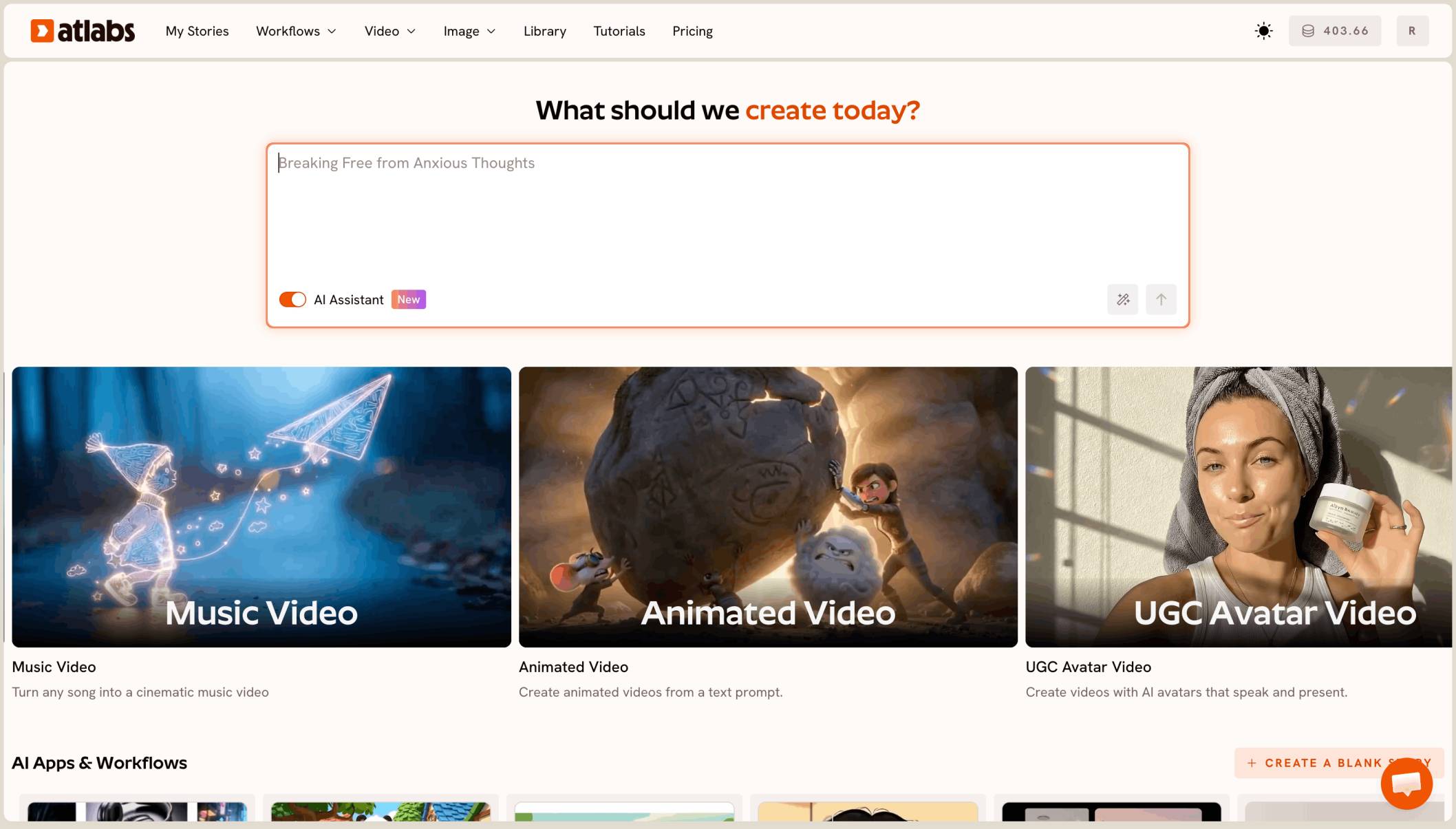
Audio-first Music Video workflow: upload an mp3 up to 200MB or paste a Suno URL, then click Extract Music.
Two video types: Narrative (a story across scenes) or Performance (a lip-synced performance video).
Set Style: 9:16, 16:9, or 1:1 plus a Realistic visual style and AI Video generation.
Concepts: six scene concepts generated from your track's tempo, mood, and genre.
Cast: each character gets a reference sheet, so the same face holds across every scene.
Multi-model: Kling 3.0 and Google Veo 3.1; finish with Lip Sync, Reframe, and Upscale.
Pricing
Free trial: available
Pro: about $19 per month, billed annually
Verdict. The only tool here that goes from audio upload to a finished, scene-by-scene video with character consistency built in.
2. Neural Frames – The audio-reactive visualizer
Best for: Abstract, frequency-driven visualizers for electronic, ambient, and instrumental tracks.
Key features
Tightest audio-reactive coupling of any tool tested.
Strongest fit for visualizer-style content rather than on-screen performance.
Scene planning exists, but narrative coherence across a full track needs manual work.
Not performance-ready for a character singing the track on screen.
Pricing
Free tier: available
Entry plan: about €9 per month
Verdict. The strongest pure visualizer of the group. Falls behind once you need performance shots or a directed structure.
3. Runway – The cinematic clip engine
Best for: Artists comfortable editing who want the most photorealistic scene fragments.
Key features
Gen-4 / Gen-4.5 models produce some of the most photorealistic AI footage available.
High temporal consistency and smooth motion on clips up to roughly 10-20 seconds.
Motion Brush, camera and style controls, in-video editing, and an API.
Not audio aware: it generates from text prompts, so beat sync and assembly are on you.
Pricing
Free tier: 125 credits, watermarked
Standard: about $12/mo annual
Pro: about $28/mo
Verdict. Best raw clip quality. Use it as a source of footage for a manual edit, not a one-shot builder.
4. Kaiber – The stylized creative canvas
Best for: Visual experimentation and music-synced stylized loops.
Key features
Creative canvas combining images, video, and animation into evolving concepts.
Real music credibility: contributed to the visual for Linkin Park's “Lost.”
High-fidelity artistic transformations rather than photorealism.
No song-section awareness or storyboard, so assembly is manual and the canvas takes time to learn.
Pricing
Paid plans only
Entry tier: from about $5/mo (verify current tiers)
Verdict. Right for artists who treat visuals as the creative process. Too hands-on for weekly releases.
5. Pika – The fast concept sketchpad
Best for: Quickly testing short visual directions before a full production.
Key features
Pika 2.5: fast, beginner-friendly, with viral effects (Pikaffects, Pikaframes).
Outpainting handles different aspect ratios well.
Short generations (about 4-8s) and character drift limit full music-video use.
Pricing
Free tier: 480p
Standard: about $8/mo
Unlimited: about $28/mo
Verdict. A quick concept sketchpad, not a full music-video builder.
Final verdict
Pick Atlabs if you want a finished, cinematic music video from a track with consistent characters and no editing.
Pick Neural Frames if you want abstract, audio-reactive visualizers for electronic or ambient music.
Pick Runway if you want the most photorealistic clips for a manual cut.
Pick Kaiber if you want visual experimentation without weekly output.
Pick Pika if you want sketching short visual ideas fast.
FAQ
What is the best AI music video tool for indie artists in 2026?
Atlabs, because its Music Video workflow plans scenes around your song and keeps characters consistent. Neural Frames and Runway are strong for visualizers and cinematic clips but leave more assembly to you.
Can AI make a music video from just an audio file?
Yes. Audio-first tools like Atlabs take an mp3 or Suno URL and build scenes around tempo, mood, and genre. Runway and Pika start from text prompts, so they are not audio aware.
Do I need video editing skills?
Not for Atlabs, which goes from upload to a finished cut in five steps. Runway and Kaiber assume you assemble clips yourself.
Which tool keeps a character consistent across scenes?
Atlabs, through its Cast step with per-character reference sheets. Most general tools generate each clip independently, so faces drift.
Which tool has the best raw clip quality?
Runway's Gen-4. Atlabs reaches cinematic realism via Kling 3.0 and Veo 3.1 while adding the full-song workflow Runway lacks.
References & data sources
Atlabs. Five-step Music Video workflow and pricing verified via the Atlabs site and app. Pro about $19/mo annual.
Runway. Gen-4 and pricing verified via runwayml.com/pricing and ProPicked (2026).
Pika. Pika 2.5 features and tiers verified via pika.art/pricing and Neuronad (2026).
Kaiber. Positioning and entry pricing verified via Fluxnote and The AI Journal (2026).
Neural Frames. Audio-reactive positioning and pricing verified via Cybernews and The AI Journal (2026).
Pricing accurate as of June 2026 and subject to change. Verify on each tool's official site before purchasing.