In AI video generation, the only thing that separates a looping clip from a real film is how you tell the machine to move the camera.
Many people type the subject - “a cyberpunk city” - stop there. Because no camera instruction is given, the system drifts in a slow, aimless bob. If you want footage that looks as if a crew shot it, you have to phrase the order the way a Director of Photography would phrase it on set.
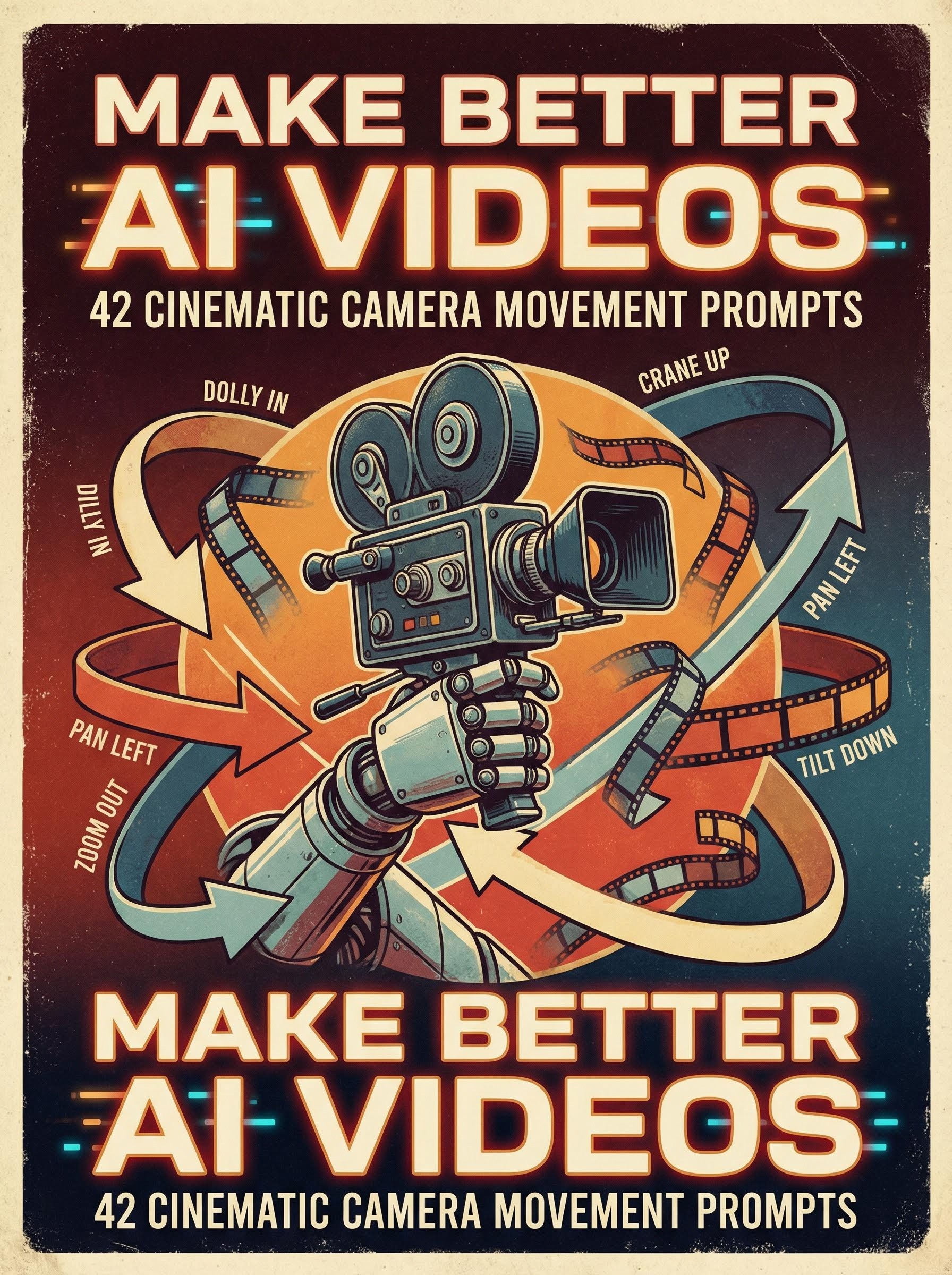
The pages that follow list forty two exact prompts for camera moves, sorted by the look they create. Each line is ready to copy and paste - no extra wording is required.
How to Use These Prompts
For the best results, place these keywords at the start or end of your prompt to prioritize movement.
Structure:
[Subject Action], [Lighting/Style], [CAMERA MOVEMENT]Example: A vintage car driving down a coastal road, sunset lighting, Low angle tracking shot, camera moves along the ground looking up.
1. Dolly Moves (Depth & Intimacy)
Use these to physically move the "camera" through 3D space, creating parallax and depth.
Slow Dolly In: Creates intimacy or tension.
Prompt:
Slow dolly in, camera moves slowly forward toward the subject.
Slow Dolly Out: Reveals context or signifies an ending.
Prompt:
Slow dolly out, camera moves slowly backwards away from the subject.
Fast Dolly In: Aggressive, used for horror or action.
Prompt:
Fast dolly in, camera moves rapidly forward toward the subject's face, urgent motion.
Vertigo Effect (Zolly): The classic "Hitchcock" psychological distortion.
Prompt:
Vertigo effect, dolly zoom, camera moves backward while zooming in, background expands.
2. Infinite Scale Continuity
Best for abstract transitions and mind-bending AI hallucinations.
Extreme Macro Zoom: Transitions from the visible world to the microscopic.
Prompt:
Extreme macro zoom, zoom transition from face to micro view of the eye.
Cosmic Hyper Zoom: The "Google Earth" effect.
Prompt:
Cosmic hyper zoom, fast zoom transition from space down to street level.
3. Character-Mounted Framing
Use these to ground the viewer in a character’s perspective.
Over the Shoulder (OTS): Standard dialogue or stalking perspective.
Prompt:
Over the shoulder shot, camera mounted behind subject A framing subject B.
Fisheye / Peephole: Stylized surveillance or door-viewer look.
Prompt:
Fisheye lens, extreme wide-angle distortion, circular frame.
4. Obstacle & Environmental Interaction
These shots create foreground depth, making the AI video feel less "flat."
Reveal from Behind (Wipe): Using an object to transition into the scene.
Prompt:
Wipe movement, camera slides laterally from behind the pillar to reveal the street.
Through Shot (Fly Through): Moving through a gap to enter a new space.
Prompt:
Fly through, camera moves through the window opening into the room.
5. Focus & Lens Manipulation
AI struggles with consistency; using focus prompts helps hide artifacts and guide the eye.
Reveal from Blur: Dreamy or waking-up effect.
Prompt:
Rack focus, start completely out of focus, slowly pull focus until sharp.
Rack Focus: Shifting attention from near to far.
Prompt:
Rack focus, focus shifts from the coffee cup to the couple in the background.
6. Tripod Moves (Stationary Pivot)
Standard, stable movements ideal for establishing shots.
Tilt Up: To reveal height (skyscrapers, giants).
Prompt:
Tilt up, camera pans vertically up from legs to head.
Tilt Down: To reveal ground elements or defeat.
Prompt:
Tilt down, camera pans vertically down from head to feet.
7. Slider Moves (Lateral Motion)
Also known as "Trucking." Great for following walking subjects from the side.
Camera Truck Left:
Prompt:
Truck left, camera moves sideways on a track to the left.
Camera Truck Right:
Prompt:
Truck right, camera moves sideways on a track to the right.
8. Orbital Movements (Rotation)
High-energy shots to showcase a subject from all angles (popular in car commercials).
Orbit 180: A standard half-circle.
Prompt:
Orbit 180, camera moves in a half-circle around the subject.
Fast 360 Orbit (The Spin): High energy, disorienting.
Prompt:
Fast 360 orbit, camera spins rapidly 360 degrees around the subject.
Slow Cinematic Arc: Dramatic and emotional.
Prompt:
Slow cinematic arc, camera moves in a wide curve to reveal side profile.
9. Vertical Movements (Crane & Pedestal)
Use these to change the height perspective.
Pedestal Down: Lowering the camera straight down.
Prompt:
Pedestal down, camera lowers vertically straight down.
Pedestal Up: Rising straight up.
Prompt:
Pedestal up, camera rises vertically straight up from waist to eye level.
Crane Up: The "Epic Movie" ending shot.
Prompt:
Crane up, camera lifts high into the air.
Crane Down: Establishing a specific location from the sky.
Prompt:
Crane down, camera descends slowly to the subject.
10. Optical Lens Effects
Simulating the lens changing, rather than the camera moving.
Smooth Optical Zoom In:
Prompt:
Smooth optical zoom in, lens magnifies subject, camera stays stationary.
Smooth Optical Zoom Out:
Prompt:
Smooth optical zoom out, lens widens, background becomes blurry.
Snap Zoom (Crash Zoom): Used in comedy or intense action (Kung Fu movies).
Prompt:
Snap zoom, crash zoom, rapid zoom directly into the eyes.
11. Drone & Aerial Views
Essential for landscapes, cities, and establishing the world.
Drone Fly Over: Standard travel videography.
Prompt:
Drone fly over, high altitude flight moving forward over the landscape.
Epic Drone Reveal: Rising over an obstacle to see the view.
Prompt:
Epic drone reveal, rising and tilting down to reveal the scene.
Large Scale Drone Orbit:
Prompt:
Large scale drone orbit, massive sweeping circle around the island.
Top Down (God's Eye): looking directly down.
Prompt:
Top down shot, camera pointing straight down, slow twist.
FPV Drone Dive: High speed, adrenaline-inducing.
Prompt:
FPV drone dive, aggressive diving motion down the waterfall.
12. Stylized & Dynamic Movements
Use these to add specific "vibes" or genres to the video.
Handheld Documentary: Adds realism and "grit."
Prompt:
Handheld camera, shaky motion, natural movement, documentary style.
Whip Pan: Perfect for hidden transitions between two clips.
Prompt:
Whip pan, camera whips violently to the side with extreme directional motion blur.
Dutch Angle (Roll): Uneasiness, madness, or villainy.
Prompt:
Dutch angle, camera roll, tilted sideways on Z-axis.
13. Subject Tracking
Keeps the subject sharp while the background moves.
Leading Shot (Backward Tracking): Moving back while the subject walks forward.
Prompt:
Leading shot, camera moves backward matching the subject's speed.
Following Shot: Chasing the subject.
Prompt:
Following shot, camera follows behind the subject matching speed.
Side Tracking: The "Walk and Talk."
Prompt:
Side tracking, camera trucks alongside the subject.
POV Walk: Immersive first-person view.
Prompt:
POV walk, first person camera moving forward with bobbing motion.
14. Time & Speed Manipulation
AI excels at morphing time.
Hyperlapse: Fast motion through a city or landscape.
Prompt:
Hyperlapse, camera moves forward rapidly, time accelerated, fast motion, light trails.
Bullet Time: The "Matrix" effect.
Prompt:
Bullet time, frozen moment, ultra slow motion, camera orbit right.
15. Extreme Orientation
For experimental and sci-fi visuals.
Barrel Roll (Vortex): Complete disorientation.
Prompt:
Barrel roll, camera spins 360 degrees clockwise while moving forward, disorienting.
Worm’s Eye Tracking: Makes the subject look massive.
Prompt:
Worm's eye view, low angle tracking, camera moves along the ground looking up.
Frequently Asked Questions (AI Video)
What is the best prompt for stable AI video movement?
For stability, use "Tripod moves" or "Slow Dolly" prompts. Avoid "Handheld" if you want a smooth, glitch-free background.
How do I stop AI video from morphing too much?
Combine a Slow Optical Zoom Out with a high "motion bucket" (if available in your tool) or lower the "creativity/chaos" parameter. Slow movement reduces artifacting.
Can I combine camera movements in one prompt?
Yes, but be careful. Combining "Orbit" and "Zoom" works (Dolly Zoom), but combining "Whip Pan" and "Macro Zoom" often confuses the AI, resulting in a blurry mess. Stick to one primary motion per clip.