Here are 100 cinematic camera prompts you can copy, paste, and shoot with today. The camera move is the difference between AI footage that looks generated and AI footage that looks directed. This library covers every move a real cinematographer would call on set: push-ins, orbits, dolly zooms, crane shots, handheld energy, speed ramps, and reveal tricks. Each prompt works in Seedance 2.0, Veo 3.1, and Kling, and you can test all of them inside Atlabs.
The Cinematic Camera Prompt Formula
AI video models respond to structure, not vibes. Writing the word cinematic into a prompt does almost nothing. Naming a real camera move, its speed, and what it should land on does everything. Every prompt in this library follows the same five part formula.
[Camera Move] + [Speed] + [Subject and Framing] + [Environment Detail] + [Lens or Look]
Here is the formula in action. Camera move: slow push-in. Speed: creeping. Subject and framing: a singer's face under a single spotlight. Environment detail: dust drifting through the beam. Lens or look: shallow depth of field, anamorphic flare. Stack those five pieces and the model stops guessing. Copy any prompt below as written, or swap the subject and keep the camera language intact.
Push-Ins and Pull-Backs (Prompts 1 to 10)
The push-in builds intensity. The pull-back builds scale. These two moves carry more emotional weight per second than any other camera language, which is why they open and close most great films.
1. Slow push-in toward a lone figure standing at the end of a rain soaked alley, neon signs reflecting in puddles, shallow depth of field, anamorphic lens flare.
2. Steady push-in on a singer's face under a single spotlight, dust particles drifting through the beam, background falling into soft black.
3. Creeping push-in through a doorway into a candlelit room, shadows stretching across wooden floorboards, gentle vignette.
4. Fast push-in on a boxer's eyes right before the bell, sweat catching the arena lights, crowd blurred behind.
5. Gentle pull-back from a child's hands folding a paper boat, widening to reveal a flooded street glowing at sunset.
6. Slow pull-back from a single campfire ember, opening up to a mountain valley under a star filled sky.
7. Dramatic pull-back through a shattered window, revealing the full scale of a burning city skyline at dusk.
8. Slow push-in across a banquet table littered with melted candles and spilled wine, ending on an empty throne.
9. Micro push-in on a ticking wristwatch, second hand snapping forward, macro detail, cold blue color grade.
10. Endless pull-back from a rooftop dancer, buildings sliding past the frame edges, city lights spreading below like circuitry.
Orbits and Arcs (Prompts 11 to 20)
Orbits wrap the viewer around a moment. They are the signature move of music videos and hero reveals because they turn a static subject into a centerpiece.
11. Slow 360 degree orbit around two dancers frozen mid spin, confetti suspended in the air, warm tungsten glow.
12. Half orbit around a chef plating a dish, steam curling upward, kitchen flames flaring in the background.
13. Rising orbit around a lighthouse at the peak of a storm, waves crashing white against black rock.
14. Tight orbit around a guitarist's hands during a solo, stage lights strobing red and blue.
15. Lazy arc around a couple slow dancing in an empty diner, jukebox glow painting the checkered floor.
16. Fast orbit around a sprinting athlete, background smearing into streaks of stadium light.
17. Descending orbit around a chess table in a smoky study, pieces casting long shadows across the board.
18. Wide arc around a horse and rider crossing a shallow river at golden hour, spray catching the sun.
19. Slow orbit around an astronaut floating in a station module, Earth rotating past the window behind.
20. Double orbit around a bride spinning in the rain, dress fanning out, streetlamps haloed in mist.
Tracking and Dolly Shots (Prompts 21 to 30)
Tracking shots create momentum. They pull the viewer alongside the action instead of watching it from a distance, which is why they dominate action sequences and walking dialogue scenes.
21. Side tracking shot following a skateboarder through a graffiti covered underpass, wheels sparking off concrete.
22. Smooth dolly alongside a train window, passing fields flickering like film frames.
23. Low tracking shot behind bare feet running through wet sand, the tide erasing each footprint.
24. Tracking shot weaving through a crowded night market, fruit stalls and hanging lanterns brushing past the lens.
25. Slow dolly across a detective's evidence wall, photographs and red string sliding through frame.
26. Front tracking shot of a marching band turning onto a main street, brass flaring in the midday sun.
27. Dolly through a museum hall at closing time, sculptures lit one by one as the camera passes.
28. Tracking shot beside galloping wild horses at dawn, golden dust blooming behind them.
29. Slow dolly down a hospital corridor at night, one flickering light at the far end.
30. Parallel tracking shot of two strangers walking opposite sidewalks, traffic streaking between them.
Crane, Jib, and Aerial Moves (Prompts 31 to 40)
Vertical movement is the fastest way to change how big a story feels. Rise for scale and spectacle, drop for intimacy. AI models handle these especially well because the motion is smooth and predictable.
31. Crane up from a street musician's open guitar case to a bird's eye view of the plaza crowd forming around him.
32. Slow jib down from cathedral ceiling frescoes to a single figure kneeling in candlelight.
33. Aerial rise over a lavender field at sunrise, rows converging toward a distant farmhouse.
34. Crane shot lifting away from a rooftop chase, revealing the maze of alleys the runner still has to cross.
35. Low drone glide over a frozen lake, cracks in the ice spidering beneath the lens.
36. Aerial pull away from a lone red umbrella crossing a gray, rain slick intersection.
37. Jib arc over a boxing ring at the moment of the knockout, flashbulbs firing from every angle.
38. Sweeping aerial along a coastal cliff road, a vintage convertible hugging every curve.
39. Vertical crane down the glass face of a skyscraper at dusk, each lit floor holding a different life.
40. Slow drone ascent through morning fog, treetops surfacing like islands.
Handheld and Documentary Energy (Prompts 41 to 50)
Handheld is the texture of truth. A little shake tells the viewer this is really happening. Use these when polished movement would feel too clean for the moment.
41. Handheld follow shot behind a protester moving through a chanting crowd, signs bobbing in and out of frame.
42. Shaky handheld sprint through a subway car as the lights stutter, passengers grabbing for the rails.
43. Intimate handheld close-up of a farmer inspecting cracked soil, fingers sifting the dust.
44. Handheld whip toward a sudden sound off screen, focus hunting before locking onto a slammed door.
45. Loose handheld drift around a band rehearsing in a garage, cables and amps crowding the frame edges.
46. Documentary style handheld interview framing, subject slightly off center, kitchen life continuing softly blurred behind.
47. Handheld chase up a narrow stairwell, breath fogging the lens on each landing.
48. Raw handheld pan across a flood damaged living room, the water line staining the walls.
49. Handheld push through backstage curtains into blinding stage light, applause swelling.
50. Unsteady handheld close-up on trembling hands opening an acceptance letter.
Zooms and Focal Tricks (Prompts 51 to 60)
This is where prompts start to feel like directing. The dolly zoom, the crash zoom, and the rack focus are the moves audiences can feel even when they cannot name them.
51. Slow dolly zoom on a man realizing the truth, the background stretching away while his face holds steady, vertigo effect.
52. Crash zoom onto a phone screen lighting up with one unread message.
53. Creeping zoom across a packed stadium to the single fan who is not celebrating.
54. Dolly zoom down a school hallway as the bell rings, lockers warping outward.
55. Snap zoom between two gunslingers' eyes at high noon, heat shimmer rising off the dirt.
56. Slow zoom out from a keyhole view into a full ballroom scene, the waltz already in motion.
57. Rack focus from raindrops on a window to a taxi waiting across the street.
58. Long lens compression shot of commuters packed on a platform, faces stacked like portraits.
59. Split diopter shot with a chess piece razor sharp in the foreground and the opponent's stare equally sharp in the distance.
60. Slow zoom into an oil painting until the brushstrokes become a living landscape.
POV and Immersive Angles (Prompts 61 to 70)
POV shots put the viewer inside the frame. They perform incredibly well on short form platforms because the first second already feels personal.
61. First person POV pushing through saloon doors, every head in the room turning toward the lens.
62. POV of a cyclist bombing a mountain switchback, handlebars vibrating at the bottom of frame.
63. Worm's eye view lying on the street, skyscrapers spinning slowly overhead as the camera rotates.
64. POV from inside a washing machine drum as laundry tumbles past in slow motion.
65. Over the shoulder POV of a pianist's hands during the final movement, keys reflecting stage light.
66. POV of a paper plane gliding through an open plan office, desks streaking below.
67. Dog height POV trotting through a farmers market, ankles and falling crumbs filling the frame.
68. POV waking up inside a tent as the zipper opens onto a mountain sunrise.
69. Glass elevator POV rising through a hotel atrium, the lobby dropping away in reflection.
70. POV of a diver stepping off the ten meter platform, the water rushing up in total silence.
Speed Ramps and Time Play (Prompts 71 to 80)
Time is a camera move too. Speed ramps, freezes, and hyperlapses are the native language of music videos and sports edits, and models like Seedance 2.0 handle them with surprising precision when the prompt names the exact moment speed should change.
71. Speed ramp from slow motion vinyl drop to real time as the beat kicks in, the party erupting around the turntable.
72. Time slice freeze around a bursting water balloon, the camera arcing through the suspended splash.
73. Slow motion ramp of a matador's cape flaring, arena dust hanging in the air like smoke.
74. Hyperlapse through a neon city at night, taillights braiding into ribbons of red.
75. Speed ramp on a basketball dunk, slowing at the rim, snapping back to full speed on the landing.
76. Timelapse inside a painter's studio from blank canvas to finished mural, shadows sweeping the floor.
77. Reverse motion shot of shattered glass reassembling into a perfect chandelier.
78. Bullet time rotation around a dancer mid leap, rain droplets frozen around her.
79. Extreme slow motion close-up on a sprinter's spikes leaving the blocks, track dust blooming.
80. Day to night timelapse locked on a lighthouse, the beam carving through the falling dark.
Reveals and Transitions (Prompts 81 to 90)
A reveal is a punchline told with a lens. These moves hide information and then hand it to the viewer at the exact right moment, which makes them the most rewatchable shots in any edit.
81. Whip pan from a laughing crowd to the empty chair where the guest of honor should be sitting.
82. Camera passes behind a stone pillar and emerges into a different decade, costumes and cars completely changed.
83. Match cut move from a spinning coin on a table to a spinning Ferris wheel at night.
84. Tilt up from muddy boots to reveal an armored knight standing in a modern parking lot.
85. Slow reveal through parting stage curtains, a silhouette resolving into the headliner.
86. Foreground wipe as a passing bus reveals the storefront suddenly boarded up.
87. Push-in toward a vanity mirror while the reflection calmly walks away on its own.
88. Pull focus reveal from foggy breath on a window to the figure standing outside in the snow.
89. Camera drops through the apartment floor into the jazz club below, the music swelling on the way down.
90. Iris style reveal opening from pure black onto a single spotlit microphone.
Genre Ready Combos (Prompts 91 to 100)
The final ten stack two moves into one shot. Use these sparingly. One combo per scene is a statement, three in a row is noise.
91. Music video combo: slow orbit tightening into a push-in on the vocalist during the chorus, stage lights blooming on the key change.
92. Action combo: handheld sprint into a whip pan as the car explodes, debris tracked in slow motion.
93. Horror combo: static wide hold on a dark hallway, then a single slow push-in that begins only after three full seconds of nothing.
94. Romance combo: two parallel tracking shots of two people converging on the same park bench, meeting in one shared frame.
95. Noir combo: venetian blind shadows raking across a slow dolly toward a ringing desk phone.
96. Western combo: extreme wide crane up as two silhouettes face off across a dust blown street.
97. Sci-fi combo: continuous drone flight through a neon city that tilts into zero gravity as the camera rolls fully upside down.
98. Documentary combo: locked tripod interview frame that gently pans only when the subject stands and walks to the window.
99. Kids animation combo: bouncing crane follow behind a paper airplane weaving through a candy colored classroom.
100. Epic finale combo: pull-back from a single raised torch to an aerial wide of ten thousand lights answering across the valley.
Which Camera Move Should You Use? Quick Reference
Camera Move | Emotional Effect | Best Fit |
|---|---|---|
Push-in | Rising tension, focus | Drama, music video choruses |
Pull-back | Scale, loneliness, closure | Endings, establishing shots |
Orbit | Importance, celebration | Music videos, hero reveals |
Tracking | Momentum, urgency | Action, walking scenes |
Crane and aerial | Awe, scope | Landscapes, finales |
Handheld | Realism, chaos | Documentary, thrillers |
Dolly zoom | Dread, realization | Horror, plot twists |
Speed ramp | Impact, rhythm | Sports, music videos |
Tutorial: How to Use These Camera Prompts in Atlabs
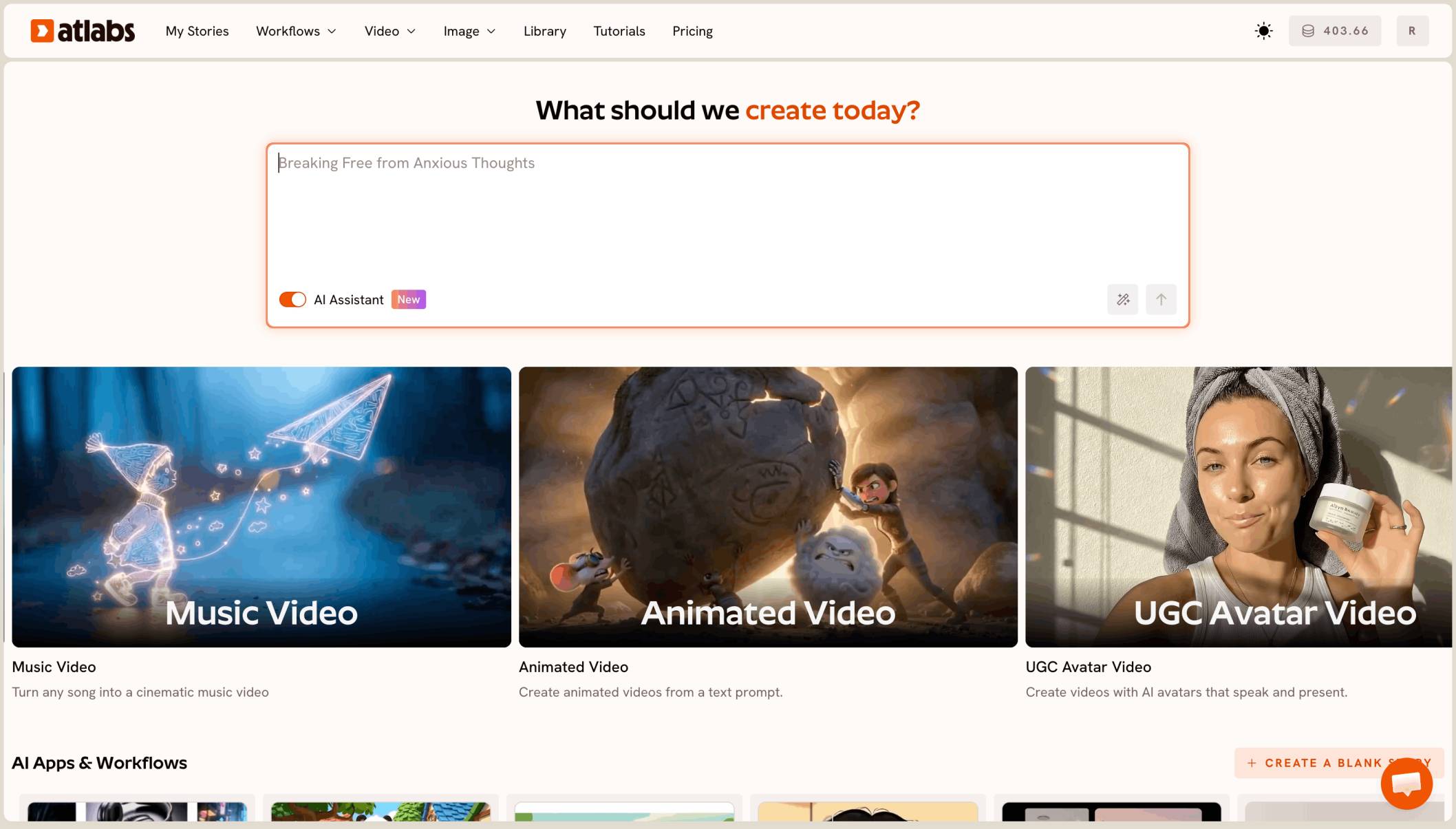
Every prompt in this library runs inside Atlabs without editing. Open the platform and pick your entry point. For a single shot, use the Image to Video tool: generate or upload a still frame, paste the camera prompt into the motion field, and pick Seedance 2.0 or Veo 3.1 as the model. Seedance 2.0 is the stronger pick for complex moves like dolly zooms and speed ramps. Veo 3.1 excels at smooth aerials and realistic handheld texture. For precise, repeatable movement, use the Motion Control tool, which lets you pair any of these prompts with a defined camera path. If you are building a full music video or animated piece, the same camera language works inside each scene's motion prompt across the whole project.
Open Atlabs and choose Image to Video or Motion Control.
Generate or upload the still frame you want to move.
Paste one camera prompt from this library into the motion prompt field.
Select Seedance 2.0 for complex moves or Veo 3.1 for smooth realism.
Generate, review the motion, and adjust the speed word if needed (slow, creeping, fast).
You might want to take a look at this video:
Three Mistakes That Ruin Camera Prompts
First, stacking moves. A prompt asking for an orbit plus a crane plus a zoom in one shot gives the model three masters to serve, and it serves none. One move per shot, two at most for a designed combo. Second, vague verbs. The camera moves cinematically means nothing to a model. Slow push-in means everything. Third, forgetting speed. The same orbit reads as romantic at slow speed and frantic at fast speed. The speed word is doing half the emotional work in every prompt above, so never leave it out.
FAQ
Do these camera prompts work in every AI video model?
Yes, with different strengths. The camera language in this library (push-in, orbit, tracking, dolly zoom) is understood by Seedance 2.0, Veo 3.1, Kling, and Runway. Seedance 2.0 handles complex moves and speed ramps best, while Veo 3.1 produces the smoothest aerials and most natural handheld texture.
What is the best AI model for camera movement prompts?
Seedance 2.0 is currently the strongest model for prompted camera movement, especially multi part moves like dolly zooms and speed ramps. Both Seedance 2.0 and Veo 3.1 are available inside Atlabs, so you can run the same prompt on each and keep the better take.
Can I combine two camera moves in one prompt?
Yes, but only two, and only when one leads into the other. Prompts 91 to 100 in this list show the pattern: name the first move, then the trigger moment, then the second move. Stacking three or more moves in a single shot confuses the model and produces drifting, aimless motion.
How do I use these prompts in Atlabs?
Open the Image to Video or Motion Control tool, paste any prompt from this list into the motion prompt field, pick your model, and generate. You can swap the subject in any prompt and keep the camera language intact, which is the fastest way to build a consistent cinematic style across a whole video.
Get started
You now have a full cinematography vocabulary in copy and paste form. Pick one prompt, drop it into Atlabs, and watch a static frame turn into a directed shot. Open Atlabs