
The Best AI Video Tools in 2026: Which One Makes a Full Cinematic Video?
Short answer: if you want a finished cinematic video and not another clip a few seconds long that you have to stitch together yourself, Atlabs AI is the pick, because it runs the whole pipeline in one place. Luma, Runway, Pika, and Kling each nail one part of that pipeline. Here is who wins at what, with prices, pros and cons, and a clear verdict for each.
The patchwork problem nobody talks about
Most creators end up juggling three or four tools at once. One for smooth motion, one for cinematic camera work, one for fast social clips. Then everything gets rebuilt by hand in an editor, audio synced manually, characters redrawn every time you switch apps. That is not a workflow. It is a patchwork, and it is where most of your time and budget quietly disappears.
So the real question is not which tool makes the prettiest five second clip. It is which tool takes you from an idea to a finished cinematic video without leaving the app. We put five of the most used AI video generators against exactly that job.
The 5 tools at a glance
Feature | Atlabs AI (Winner) | Luma Dream Machine | Runway Gen 3 | Pika Labs 2.0 | Kling AI |
|---|---|---|---|---|---|
Best for | Full cinematic storytelling, start to finish | Smooth motion, quick clips | Pro shot control | Fast social clips | Longer clips on a budget |
Max video length | Up to 15 minutes | 5 to 10 sec | 10 sec per generation | 3 to 7 sec | Up to 2 minutes |
Full script to video pipeline | Yes | Clips only | Manual | Clips only | Clips only |
Character consistency | Built in casting | None | Needs references | Limited | Partial |
Lip sync | Built in | None | Available | Limited | Native audio |
Multi language export | 40+ languages | None | None | None | None |
AI models included | 100+ in one login | Luma only | Runway plus a few | Pika only | Kling only |
Free tier | Yes | Yes | One time credits | Yes | Yes, daily |
Starting paid price | From $19/mo | From $9.99/mo | From $15/mo | From $8/mo | From $6.99/mo |
Prices checked July 2026 for entry paid tiers. All five offer a free way to start. Plans and credits change often, so confirm on each site.
Atlabs AI
Best overall. Free plan to start, paid from $19/month.
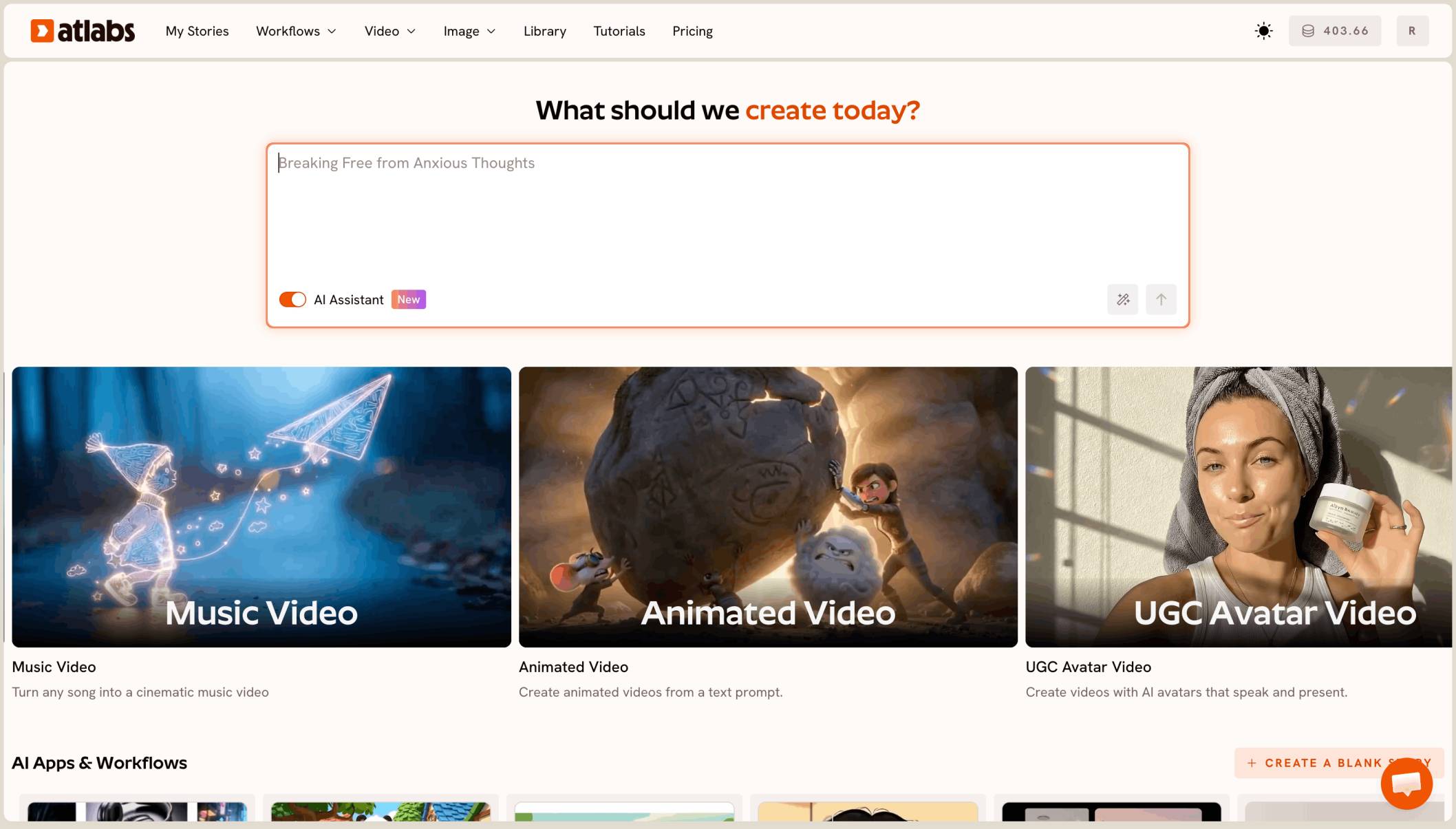
Every other tool here solves one part of the cinematic video problem. Atlabs handles all of it inside one flow, so nothing gets exported and re imported halfway through.
Key points
One place for the whole film: script, style, character casting, generation, lip sync, and export.
Over 100 AI models on one login, including Google Veo 3.1, Kling, Seedance 2.0, and Nano Banana, so you use the right model for each shot.
Character Casting keeps the same face, outfit, and voice across every scene, with no drift between cuts.
Videos up to 15 minutes, export in 40+ languages, and send straight to Premiere Pro.
Pros
A real end to end pipeline, no stitching in a separate editor
Character and voice consistency across a whole video
100+ models bundled, so it replaces several subscriptions
Multi language export and lip sync built in
Cons
Credit based, so heavy 4K use needs budgeting
The depth of features takes a little exploring at first
Verdict: The only tool here that takes you from a blank script to a finished, consistent film without leaving the app.
Luma Dream Machine
Best for motion. Free tier, paid from about $9.99/month.
Key points
Some of the smoothest, most natural motion in the whole category.
Handheld camera simulation adds a documentary texture that reads as properly cinematic.
It makes clips, not stories. There is no character memory and no voice.
Pros
Beautiful, natural movement
Fast rendering
Strong free tier for testing
Cons
Clips only, no multi scene story flow
No character consistency or built in voice
Sometimes reinterprets your subject freely
Verdict: A great motion engine to feed into a bigger pipeline, not a full video maker on its own.
Runway Gen 3
Best for control. Free tier, paid from $15/month, or $12/month billed annually.
Key points
The most precise camera and motion controls of any tool here.
Motion Brush and character references give you shot level control.
It is a tool, not a workflow. You bring the script, the voice, and the edit.
Pros
Frame level creative control
Strong editing and reference tools
Growing multi model access on paid plans
Cons
10 second clip cap means lots of stitching for longer pieces
Credit burn adds up on the flagship model
Steeper learning curve
Verdict: Best when you have a post team and need precise control over a short, high end cut.
Pika Labs 2.0
Best for beginners. Free tier, paid from $8/month.
Key points
The friendliest interface on the list, with forgiving prompts and fast results.
Scene Ingredients lets you pin specific elements into a shot, handy for brand assets.
The ceiling is the lowest here. Clips run 3 to 7 seconds.
Pros
Easiest starting point for AI video
Quick, fun clips for social
Lowest learning curve
Cons
Very short clips
Limited character consistency
Not built for multi scene stories
Verdict: Pick it for quick social posts and experiments, not for a narrative.
Kling AI
Best long clips on a budget. Free daily credits, paid from about $6.99/month.
Key points
Long clips, up to a couple of minutes at 1080p.
Among the best physics simulation for water, fabric, and human motion.
Also available inside Atlabs as one of the bundled models, so you get its quality without a separate subscription.
Pros
Long, realistic clips
Strong motion and physics
Very low entry price
Cons
Thinner editorial control than Runway
No built in multi scene story flow
Credit expiry and billing complaints in reviews
Verdict: A strong value pick for longer clips, and even better used inside Atlabs for full control.
Watch Atlabs in action
Prefer to see it before you try it? This short walkthrough shows how a script becomes a finished cinematic video, with consistent characters and voices, inside Atlabs.
So which one should you pick?
Pick Atlabs if you are a filmmaker, marketer, or lean team producing story driven video, because it is the only option here with a full script to finished video pipeline. Pick Luma if you want gorgeous cinematic clips fast and plan to edit them together yourself. Pick Runway if you have a post team and need frame level camera control for a short, high end cut. Pick Pika if you are just getting started and want quick social clips with almost no learning curve. Pick Kling if you need longer, realistic clips on a tight budget, or reach it inside Atlabs for the same quality with more control around it.
The bottom line
Most AI video tools are model wrappers: a text box and a download button. Atlabs is a production platform, which in practice means 100+ models on one login, character consistency that holds across a whole film, a true script to video pipeline, and export built for how content actually ships. That is why it wins for a full cinematic video.
Frequently asked questions
Which AI video tool is best for a full cinematic video? Atlabs, because it runs script, style, casting, generation, lip sync, and export in one place. The others make strong individual clips but leave the stitching to you.
Is Runway or Kling better than Atlabs? Runway gives finer control on a single shot, and Kling gives longer clips at a low price, so they win on those narrow jobs. For a complete, consistent video, Atlabs covers the whole pipeline they do not.
Do these tools have a free plan? Yes. All five offer a free way to start. Atlabs, Luma, Pika, and Kling have free tiers, and Runway gives one time starter credits.
How much do the tools cost? Entry paid plans start around $6.99/month for Kling, $8 for Pika, $9.99 for Luma, $15 for Runway, and $19 for Atlabs. Atlabs bundles 100+ models and the full pipeline into that price. Figures checked July 2026 and subject to change.