The best AI tools for faceless kids YouTube channels in 2026 are Atlabs AI, Kling 3.0, Runway, Pika and Higgsfield, and the right pick depends almost entirely on how often you plan to upload. A faceless kids channel lives or dies on two things: how fast you can publish, and whether the bear in episode four still looks like the bear in episode one. Most creators start with an AI kids video generator, get three good clips, then hit the wall when they try to turn those clips into an eight minute story that a four year old will actually sit through. The problem is rarely the model. It is the twelve steps between a story idea and a finished upload.
Why Faceless Kids Channels Need Different AI Animation Tools
Kids content carries constraints that adult content does not. Characters have to stay identical across an entire series, because a preschooler notices when the rabbit changes colour halfway through and a parent notices when the channel looks careless. Episodes run long, often six to ten minutes, which means twenty or more generated shots stitched together rather than one hero clip. Narration carries the story, so the voice has to match the character on screen and hold the same accent and tone across every episode you publish.
Then there is the volume problem. Kids channels reward frequency. Publishing once a week does not build a watch history the way publishing four times a week does, and most creators discover that a tool which produces one beautiful ten second clip in twenty minutes cannot support that cadence. Add captions for the parents watching on mute, vertical variants for Shorts, and a thumbnail per episode, and a single upload becomes an afternoon of tool switching. The creators who scale are not the ones with the best prompts. They are the ones who cut the number of tools sitting between script and export.
Comparison at a Glance
Tool | Best For | Key Advantage for Kids Content | Tradeoffs |
|---|---|---|---|
Atlabs AI | Full episode production from script to captioned export | Script, animation, cast, voice sync and captions run inside one connected set of workflows, with model swapping per shot | Built around workflows rather than a timeline, so heavy manual frame editing sits outside it |
Kling 3.0 | Long clips and high volume output | Multi shot sequences with subject consistency across camera angles, plus long single pass durations that suit story scenes | Model access only, so scripting, casting and captions still need separate tools |
Runway | Precise shot level direction | Motion brush, camera path control and reference driven character consistency give the tightest control over a single shot | Clip lengths stay short, so long kids episodes mean a lot of assembly work |
Pika | Playful, physics driven visual moments | Physics aware motion suits slapstick, squash and stretch, and toy style cartoon animation | Better at moments than at narrative continuity across a full episode |
Higgsfield | Cinematic direction and multi model access | Per shot camera controls and character identity references from a single workspace | Aimed at social and marketing output rather than long form children's series |
1. Atlabs AI
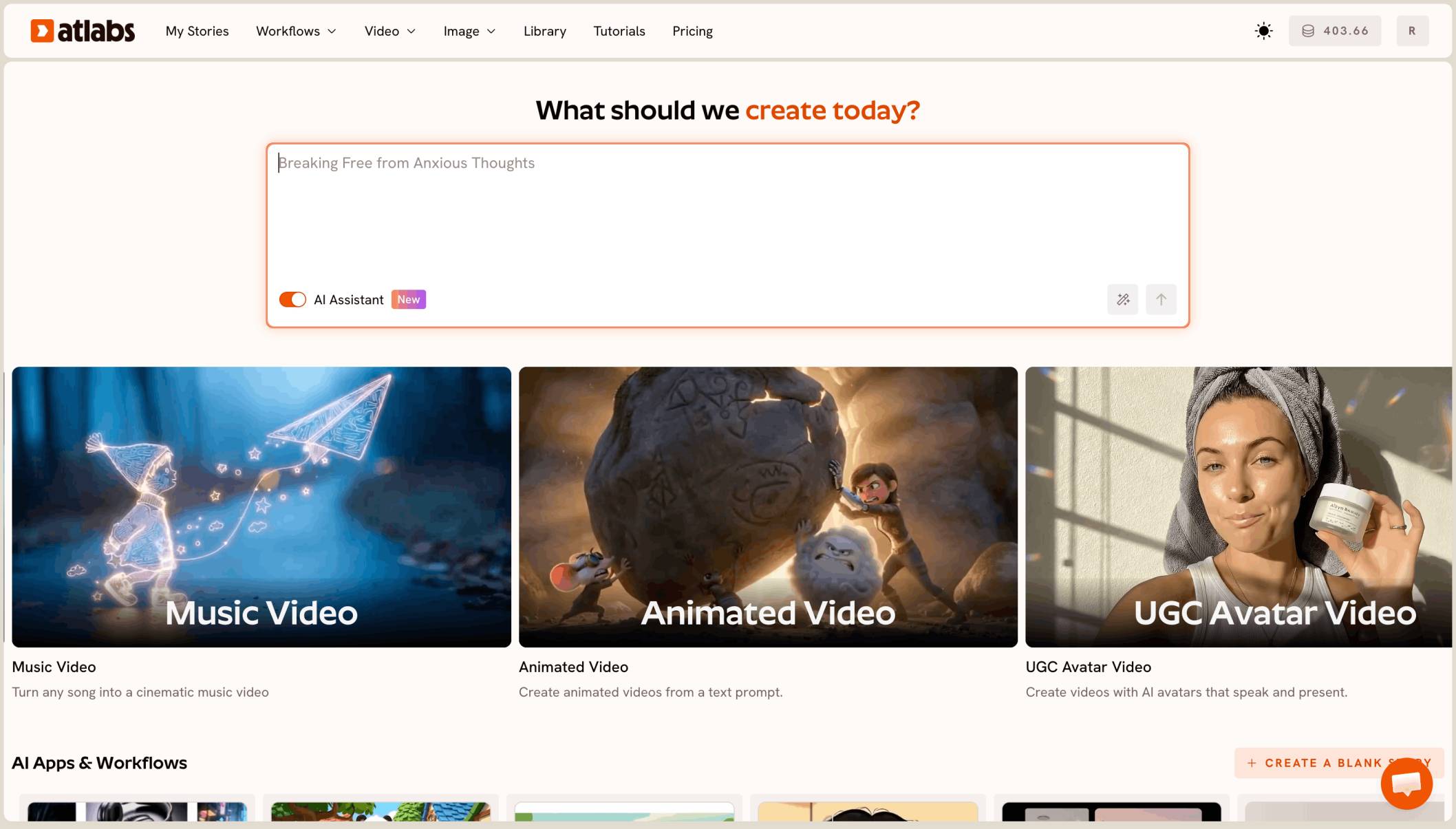
Atlabs is a multi model AI video generation platform, which in practice means you reach several video and image models through one interface instead of holding separate accounts for each. For a kids channel that matters less as a convenience and more as a production decision, because different shots in the same episode want different models. A slow storybook pan and a chase scene through a forest are not the same problem, and routing them differently without leaving the workflow is what keeps an episode consistent.
Animated Video, the AI animation tool for cartoons and nursery rhymes
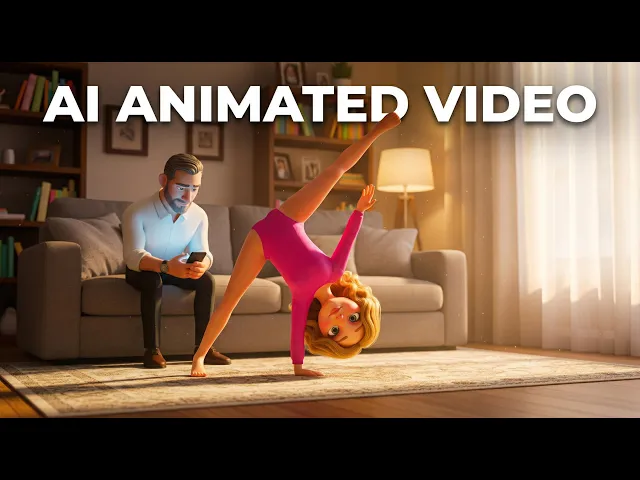
The Animated Video workflow builds animated video from a text prompt and is the one to reach for on kids content, anime style work, and explainer animation. Model routing typically favours Seedance 2.0 for stylised character work, which is what most kids animation is, and Hailuo 2.3 when a scene needs high motion fluidity. If your series leans towards very simple visuals where the style is the point, Stick Style generates stick figure animation from a script and covers the lower fidelity end of the same shelf.
The Set Style visual style library is where a kids channel finds its look and then keeps it. Options include 3D Cartoon, Storybook, Clay, Modern Cartoon, Spooky Cute, Watercolor Ink and Flat 2D Modern, alongside Anime and Semi-Realism for older audiences. Picking one and holding it across a season is the cheapest way to make a channel look intentional, and it is the single biggest visual difference between a channel that reads as a series and one that reads as a folder of clips. Aspect Ratio covers 16:9 for the main YouTube upload, 9:16 for Shorts, and 1:1, so the same episode feeds more than one surface.
Script to Video, where long kids episodes get manageable
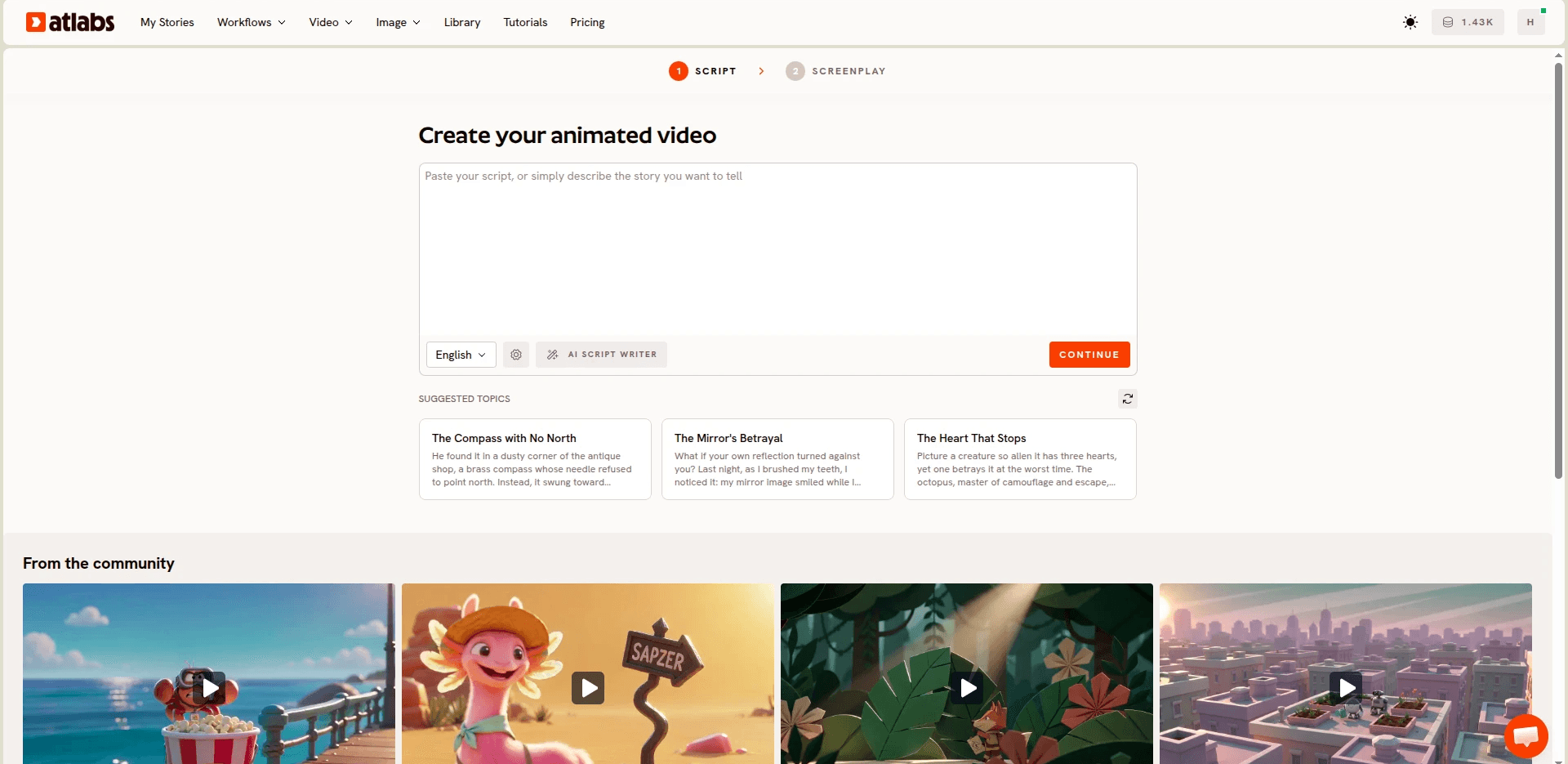
Six to ten minute stories are a scripting problem before they are a rendering problem, and Script to Video is built for that. Step 1 gives two input modes. "Add your script" is free form text entry with a language selector, an AI Script Writer button, and a Suggested Scripts panel offering three AI generated starting points, which is useful when you are filling a content calendar rather than chasing one idea. "Add your screenplay" is the structured mode, and when Atlabs detects screenplay formatting it prompts "Screenplay Detected" and moves you into a dedicated section with better formatting.
Screenplay mode is where a kids series stops being a pile of clips. The left panel shows the AI analysed Narrator Voice as a Country Accent plus a named voice style, along with Locations and Actors pulled from the script. The right panel breaks the story out scene by scene with Location Type set to Exterior or Interior, the Location itself, and Time of Day, and inside each scene it lists individual SHOT descriptions and DIALOGUE blocks carrying character name, spoken line and delivery tone. Shots and dialogue can be added or removed per scene, and a screenplay can be imported from JSON if you generate scripts elsewhere.
Step 2 is Set Style, with the same Aspect Ratio options and a Video Style choice between AI Video (Recommended), AI Storyboard, and Upload if you are bringing your own media. Step 3 is Finalize Cast, with Country Accent and Narrator Voice dropdowns and every character extracted from the script listed with "Click to Edit" plus an "Add Character" option. That cast list is what keeps the rabbit the same rabbit in episode nine.
Build a full episode in the Script to Video workflow
Lip Sync and Caption Video, the finishing pass
Kids characters that talk need mouths that match, and the Lip Sync app handles that from an image or video plus an audio file. It accepts a character image up to 20MB or a video up to 200MB, and an audio file between 2 and 120 seconds, with the flow shown in the interface as upload an image, add an audio file, then select a model and generate. If you record your own narration or use a fixed voice for a recurring character, this is how that voice lands on the character rather than sitting over the top of it.
Caption Video auto captions the finished episode with style options, which is not a cosmetic step on kids content. A large share of children's video is watched with the sound down in a waiting room or a back seat, and captions also give YouTube more text to understand what the episode is about.
When Should You Choose Atlabs?
Choose Atlabs when your bottleneck is the number of steps between a story idea and a finished upload, not the quality of any single ten second clip. If you are publishing a recurring series with named characters, narration, long runtimes and a fixed visual style, having the script breakdown, the cast, the model choice, the lip sync and the captions in one connected set of workflows removes most of the handoffs where episodes usually stall. If you mainly want one striking clip for a Short and you enjoy hand crafting it shot by shot, a model first tool will suit you better.
2. Kling 3.0
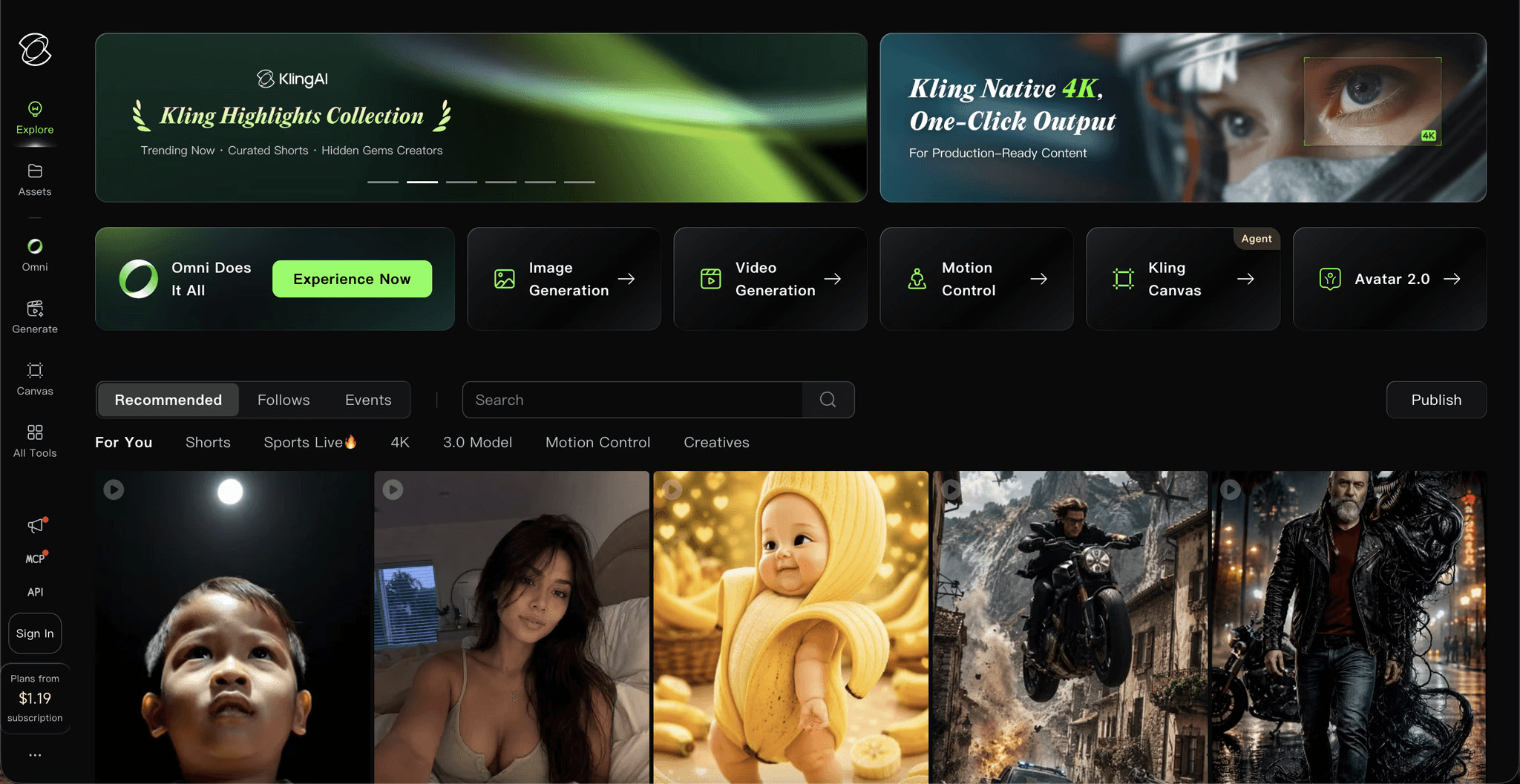
Kling has become the volume option, and volume is what a kids channel needs. Version 3.0 introduced multi shot sequences that hold subject consistency across different camera angles inside a single generation, which is a real advantage when a scene is actually three shots. It also supports far longer single pass durations than most rivals, along with native audio and 4K output, so a story beat can play out without being chopped into five second fragments and reassembled.
Where it falls short for a faceless kids channel is everything around the model. Kling gives you generation, not production. Scripts, character definitions, narrator casting, lip sync on a stylised character, captions and aspect ratio variants all still live somewhere else, which means your episode workflow spans several tabs and several subscriptions. It suits creators who already have a scripting and editing setup they like and want the strongest generation engine feeding it.
3. Runway
Runway remains the choice when you want to direct a shot rather than describe it. Gen-4 and Gen-4.5 carry the most mature creative control set in the category, including camera path control, motion brushes that direct movement on separate parts of an image independently, reference driven character consistency, and native lip sync. For a kids channel, that control pays off on the handful of shots that define an episode: the character reveal, the emotional beat, the recurring intro sequence.
The limitation is arithmetic. Runway clips typically run five to ten seconds, so an eight minute episode means generating and assembling somewhere near fifty clips, and character consistency across that many separate generations still needs iteration and cherry picking. That is workable for a hero shot and painful as a weekly production model. Runway works best as a precision tool inside a larger workflow, not as the workflow itself.
4. Pika
Pika has carved out the playful end of the category, and playful describes most kids content. The 2.5 engine is built around physics aware motion, so it understands the squish of a balloon, the weight of a fall and the flow of liquid, which maps well onto slapstick, toy animation and the exaggerated cause and effect young audiences respond to. Pikaframes gives control over aspect ratio so a clip formats natively for YouTube or Shorts, effects tooling covers stylised visual moments, integrated sound effect generation matches audio to on screen action, and lip sync handles more complex facial expressions than earlier versions.
What Pika is less suited to is continuity. It is strong at moments and weaker at holding a character and a world steady across a twenty shot narrative. For a channel built on recurring characters, that gap shows up around episode three. Use Pika for the visual gag, the effect shot, the Short that has to stop a thumb, and pair it with something that carries the story.
5. Higgsfield
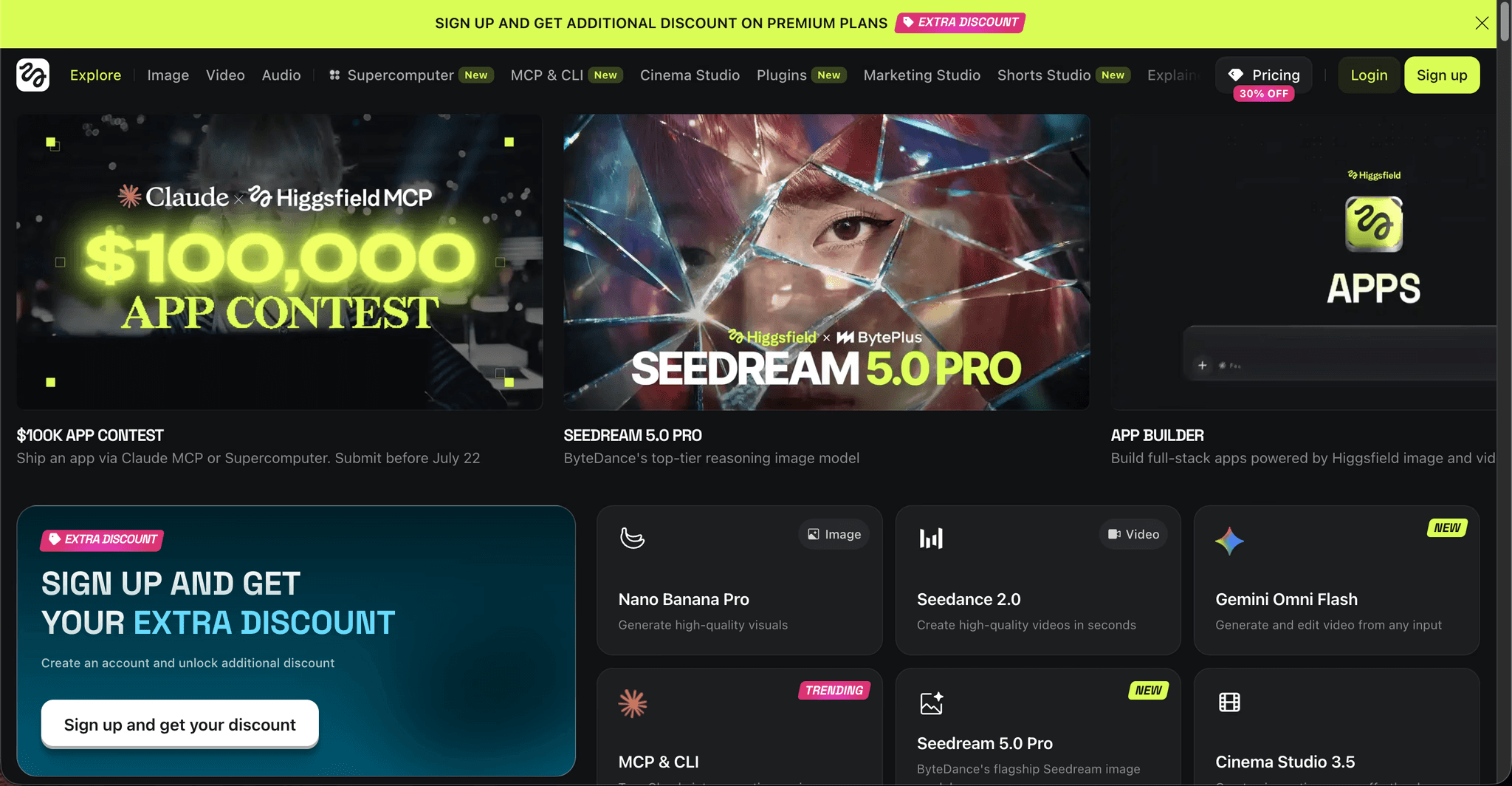
Higgsfield has grown from a video generator into a broader production environment, and its Cinema Studio setup is aimed at narrative work. An AI Director function takes a concept and breaks it into individual shots, per shot camera controls expose real directorial choices like dollies, trucks, pans and tilts, and Soul ID lets you define a character from a reference image and carry that identity across later generations. It also aggregates many leading models in one workspace, so you are not locked to a single aesthetic.
The mismatch for kids channels is positioning. Higgsfield's centre of gravity is social first and marketing content, with a Marketing Studio, hook generators and URL to video ad tooling. Those are useful for a brand pushing short form and less relevant to a creator publishing a ten minute bedtime story. If you run brand work alongside your channel, the overlap helps. If your output is purely long form children's animation, you will use a small slice of what you are paying for.
How to Make Kids YouTube Videos Using AI, Step-by-Step
Start with the story, not the visuals. Write or generate a short script with a clear problem, a middle and a resolution, because a kids episode that wanders loses its audience in the first ninety seconds. If you are working from a nursery rhyme rather than an original story, treat each verse as a scene and give each one a location and a time of day so the visuals change as the song moves.
Next, lock your cast before you generate anything. Define each character once, in writing, with age, colour, clothing and one distinguishing feature, then reuse that exact description in every prompt for that character. This is the step most beginners skip and the one that decides whether your series looks like a series.
Then generate scene by scene rather than episode by episode. Keep the visual style value identical across every shot, generate the establishing shot first so you can match lighting in the rest, and only move on once a scene reads correctly at full speed. Once the visuals are locked, add narration and run it through lip sync so the mouths match, then caption the finished cut and export a 9:16 version of your strongest thirty seconds as a Short pointing back at the full episode.
Try the workflow inside the platform
How to Choose the Right AI Kids Video Generator
Start from your upload target, not your favourite model. If you plan to publish once or twice a month and each episode is a showpiece, a shot level tool like Runway rewards the time you spend on it. If you plan to publish three or four times a week, every manual handoff you keep in the process will eventually stop you, and the deciding factor becomes how much of the pipeline lives in one place.
Next, count your recurring characters. A channel with one narrator and generic scenery can survive on a generation only tool. A channel with a cast that reappears every episode needs a place where that cast is stored and reused, which is what the Finalize Cast step exists for. Then check runtime. Under sixty seconds, almost anything works. Over five minutes, you need scene structure before you need visual polish. Finally, decide whether you want to choose models per shot or accept one house look. Multi model routing is worth more on a long series than on a one off clip, because episodes vary and a single model rarely flatters every scene in a story.
Example Prompts for Kids Cartoon and Nursery Rhyme Videos
Each prompt below is written to produce a usable result on the first attempt. Keep the same visual style value across an entire series so your episodes look like a set.
A small round hedgehog with oversized round glasses tiptoes across a moonlit vegetable garden, pausing to sniff a glowing tomato that pulses softly with warm orange light. Slow low angle dolly following just behind the hedgehog at ground level, soft rim lighting from a full moon, gentle depth of field, cosy and curious mood, Storybook visual style with painted paper textures. (Best routed through Seedance 2.0) Try this prompt in the Atlabs Animated Video workflow
Five clay style ducklings waddle out of a red barn door one at a time and line up behind their mother, the last one tripping and hopping back into place. Wide static shot with a slight handheld sway, midday sunlight with soft bounce from a dirt path, cheerful counting rhythm mood, Clay visual style with visible fingerprint texture. (Best routed through Hailuo 2.3) Try this prompt in the Atlabs Animated Video workflow
A young girl in a yellow raincoat opens a wooden door in the trunk of an old oak tree and steps into a library where the books float gently in mid air. Camera pushes in slowly through the doorway then tilts up to follow the drifting books, warm lantern light against cool blue exterior, wonder and hush, 3D Cartoon visual style. Try this prompt in the Atlabs Animated Video workflow
A friendly striped cat teaches counting by stacking five wooden blocks on a kitchen table, knocking them over on the fifth block and starting again with a shrug. Locked off medium shot at table height, soft window light from the left, patient and funny mood, Modern Cartoon visual style with bold clean outlines. Try this prompt in the Atlabs Animated Video workflow
A tiny paper boat carrying two mouse siblings sails down a rain gutter after a storm, passing under leaf bridges and past a snail waving from a kerb. Side tracking shot moving with the boat at water level, overcast diffused light with fresh rain sparkle, adventurous and gentle mood, Watercolor Ink visual style. Try this prompt in the Atlabs Animated Video workflow
A slightly nervous ghost with a bedsheet body practises saying hello in a bathroom mirror inside a friendly haunted house, then floats away pleased with itself. Slow orbit around the ghost ending on the mirror reflection, soft purple and teal lighting with a warm practical lamp, silly and reassuring mood, Spooky Cute visual style. Try this prompt in the Atlabs Animated Video workflow
Interior, forest workshop, morning. A woodpecker carpenter explains to a nervous squirrel why the new nest door will not stick this winter, gesturing at the frame with a tiny pencil behind one ear. Two shot at eye level with a soft rack focus between the characters, dust motes in shafts of morning light, warm and instructive mood, Flat 2D Modern visual style. Try this prompt in the Atlabs Script to Video workflow
A grandmother owl reads the closing lines of a bedtime story to three sleepy owlets tucked into a hollow, her narration slowing as their eyes close. Slow push in from wide to medium, dim amber lantern glow with deep blue night outside the hollow, tender and calm mood, Storybook visual style. Try this prompt in the Atlabs Script to Video workflow
Once a character is generated, run the narration through Lip Sync so the mouth movement matches the voice you have cast for that character across the series.
FAQ
What is the best AI tool for a faceless kids YouTube channel in 2026? For recurring series with named characters and episodes over five minutes, a workflow based platform like Atlabs suits the cadence, because script structure, cast, model choice, lip sync and captions stay connected. For occasional showpiece clips, Runway offers more shot level control, and for long single pass scenes at volume, Kling 3.0 is the stronger generation engine.
Can I start a faceless kids YouTube channel with free AI tools? You can test with free tiers, and most of the tools here offer one, but free tiers are built for evaluation rather than production. They generally cap resolution, add watermarks and limit how many generations you can run in a day, which is workable for a first episode and not workable for a three uploads a week schedule. Use the free tier to decide whether a tool's animation style fits your channel, then judge it on whether it can carry a full episode.
How do I make nursery rhyme videos for YouTube with AI? Treat each verse as its own scene with a distinct location and time of day, keep one visual style across the whole video, and define the characters once so they stay identical from verse to verse. Generate the visuals scene by scene, then sync the vocal track to the character using Lip Sync and caption the final cut.
Can I keep the same characters across every episode? Yes, if your tool stores a cast. In Atlabs, the Finalize Cast step lists every character extracted from your script with an option to edit each one and add new ones, so the same definitions carry forward. On the model side, Seedance 2.0 is the stronger route for holding stylised character appearance across separate generations.
How long should a faceless kids YouTube episode be? Most successful kids channels sit between six and ten minutes for main uploads, with 30 to 60 second Shorts feeding discovery. Decide the runtime before you pick a tool, because long episodes need scene structure and short clips do not.
Do I need a voice actor for narration? No. Script to Video includes Country Accent and Narrator Voice selection, and the screenplay view assigns a named narrator voice style automatically from your script. If you prefer your own recording, Lip Sync accepts an audio file between 2 and 120 seconds and matches it to your character.
Final Verdict
There is no single tool that wins every part of a faceless kids channel, but there is a clear split between tools that generate clips and tools that produce episodes. Kling, Runway, Pika and Higgsfield each own a specific strength, whether that is long durations, shot control, playful physics or cinematic direction, and each leaves you to solve scripting, casting, voice and captions somewhere else. If your channel depends on shipping a recurring series with a stable cast and a consistent look, the tool that removes the most handoffs is the one that decides whether you are still publishing in six months.