Same structure as the Masha and Shaun blogs. One note up front: this style needs a slightly different treatment from the kids ones, because the whole appeal of Rick and Morty is dense dialogue rather than silent visual comedy, and because it is adult animation, which changes both the writing approach and the monetization path. I have built the guide around those differences rather than reskinning the Shaun post.
SEO Metadata
Title: How to Make Rick and Morty Style Animated Cartoons with AI in 2026 (Step-by-Step)
Slug: how-to-make-rick-and-morty-style-animated-cartoons-with-ai-2026
Meta description: Learn how to make Rick and Morty style animated cartoons with AI in 2026. Step-by-step guide covering sci-fi comedy scriptwriting, flat 2D adult animation style direction, character consistency across episodes, dialogue-heavy scene pacing, and the full production workflow for adult animation creators.
How to Make Rick and Morty Style Animated Cartoons with AI in 2026 (Step-by-Step)
Yes, you can make Rick and Morty style animated cartoons without a writers room, a storyboard team, or the nine months a single adult animation episode traditionally takes. The distinctive flat 2D look, the queasy green and purple sci-fi palette, the noodle-limbed character construction and the rapid-fire dialogue comedy can all be produced with AI video generation combined with tight scriptwriting, locked character design and deliberate scene pacing. In 2026, adult animation creators are shipping episodes solo by pairing sharp writing with AI generation, a consistent cast system and iteration at the scene level.
Rick and Morty works for a specific reason worth understanding before you copy anything: the animation is deliberately simple so the writing can be complicated. Flat shapes, thin outlines, minimal shading. That simplicity is not a budget compromise, it is a design decision that puts all the audience attention on dialogue, timing and ideas. This is the opposite of the stop-motion approach, and it changes what you optimize for. Your series can work the same way. This guide walks through the exact workflow, step by step, with real workflow images showing where to click and what to configure.
Start Your Animation Project Now
Step 1: Write Your Script Around a High Concept and Fast Dialogue
The foundation of this style is a script that opens with a strange sci-fi premise and then plays it completely straight while the characters bicker through it. The formula is remarkably consistent: an absurd concept stated flatly in the first thirty seconds, characters who react to it with irritation rather than wonder, an escalation that follows the premise to its most uncomfortable logical end, and a punchline that lands emotionally rather than cleanly.
Write your premise as a single sentence before you write a word of dialogue. "A vending machine achieves sentience and immediately files for workers' compensation." "A man clones himself to avoid a dinner party and the clone gets the better life." If the premise is not funny stated in one line, no amount of dialogue will rescue it. This is where the style is won or lost.
Then write the dialogue fast and overlapping. Characters in this genre interrupt, talk past each other, trail off, and pile qualifiers onto sentences. They also state their emotional damage bluntly in the middle of a chase sequence, which is the tonal signature of the whole genre: cosmic scale plus petty domestic grievance in the same breath. Give one character maximum confidence and minimum patience, and another maximum anxiety and minimum agency, and most scenes write themselves from that friction.
Keep episodes tight. A ten to fifteen minute runtime is where this format sits comfortably, and Atlabs supports videos up to 15 minutes, so a full episode fits in a single production run.
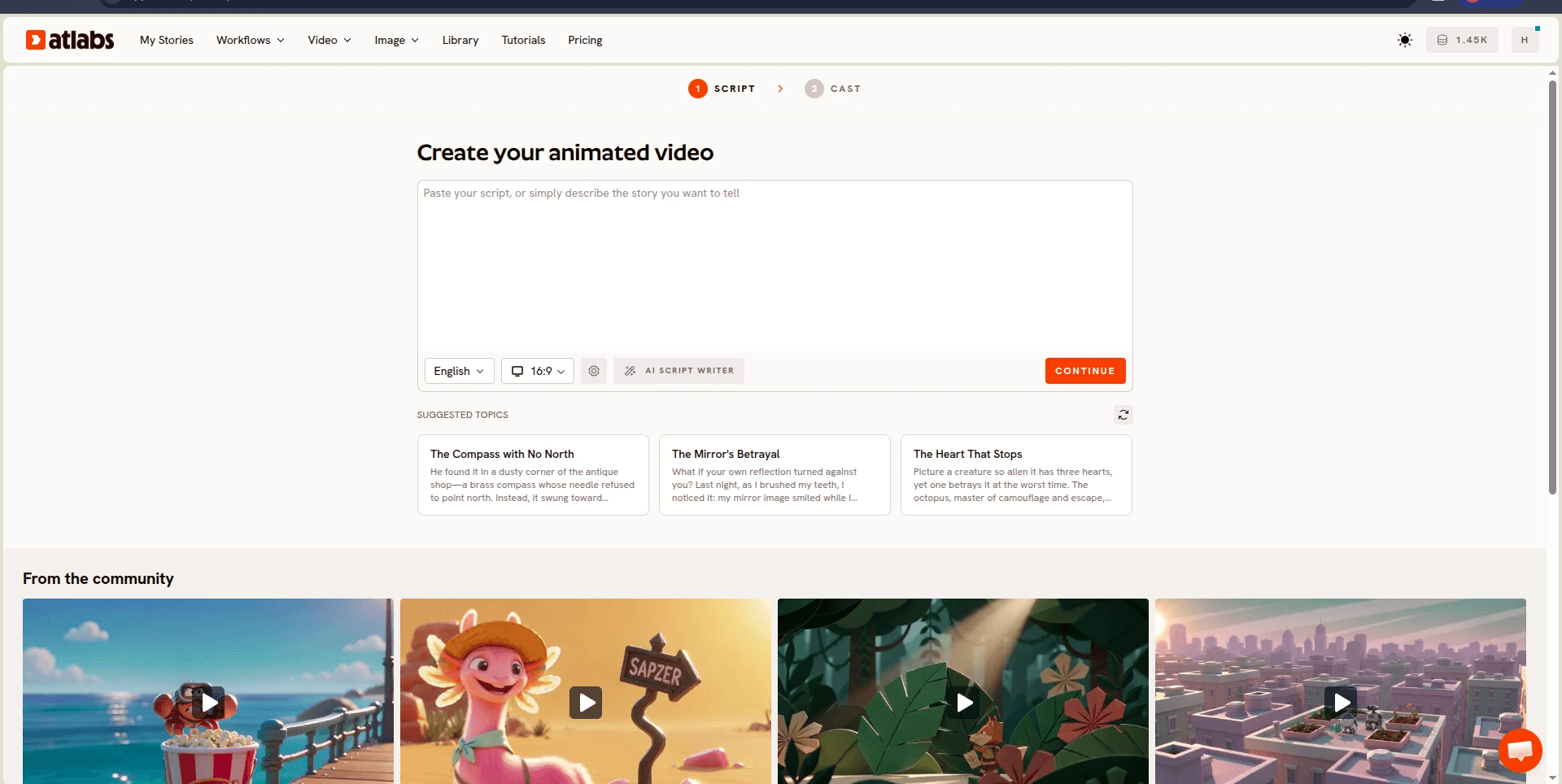
Paste your script into the Script step of the Atlabs Animated Video workflow, or start from your one-line premise and let the AI Script Writer expand it into a structured script. The platform parses your scenes, detects characters and dialogue, and carries your character definitions through generation.
[Screenshot: Script step of the Atlabs Animated Video workflow showing the script input box with a sci-fi comedy script pasted in, the language selector, and the AI Script Writer button]
Explore the animated video workflow
Step 2: Direct a Flat 2D Adult Animation Style
The visual language here is specific and easy to describe precisely, which is good news for AI direction. Flat vector shapes with no gradients. Thin, consistent black outlines that never vary in weight. Characters built from simple ovals with noodle arms and oversized heads. Eyes as plain white circles with small dark pupils, which is what lets the face carry so much comedy from so little detail. Backgrounds that are more detailed than the characters, often full of grimy sci-fi clutter, so the flat characters pop against them. And a palette that leans sickly: acid greens, bruise purples, beige interiors, cold clinical whites.
In the Style step, choose a flat 2D vector style as your base, then sharpen it with description. Write your direction physically: "flat 2D vector animation, uniform thin black linework, no gradients or soft shading, simple oval character construction with thin tubular limbs and oversized heads, plain white circular eyes with small pupils, detailed cluttered sci-fi backgrounds behind flat foreground characters, acid green and purple palette with beige domestic interiors."
Because this look is so specific and you will want it identical across an entire series, this is a strong case for training a custom style. Train it once on your reference frames and every future episode inherits it automatically, which removes the biggest failure point in a long-running series: style drift between episode two and episode twenty.
Set your aspect ratio in the same step. 16:9 for full YouTube episodes, with a 9:16 reframe generated later for clip promotion, which is how most adult animation channels actually grow.
Then test before committing. Generate two or three sample scenes with your characters in different settings and emotional states. Are the outlines consistent? Do the characters read as flat against detailed backgrounds, or has everything drifted toward soft 3D rendering? Push words like "flat," "vector," "no shading" and "uniform linework" if it is drifting.
Design your series style today
Step 3: Lock Your Characters and Their Voices
In dialogue-driven animation, character consistency has two halves, and most creators only plan for one. The visual lock matters, but the vocal lock matters just as much, because your audience identifies these characters primarily by how they talk.
For the visual half, design each character with reproducible precision. Define head shape, hair silhouette, eye size, the exact outfit including color codes, posture, and one instantly readable distinguishing feature. In flat 2D, silhouette does the heavy lifting, so give every character a different overall shape: one tall and hunched, one short and rigid, one round and slouched. If two characters have similar silhouettes, viewers lose track of them in wide shots.
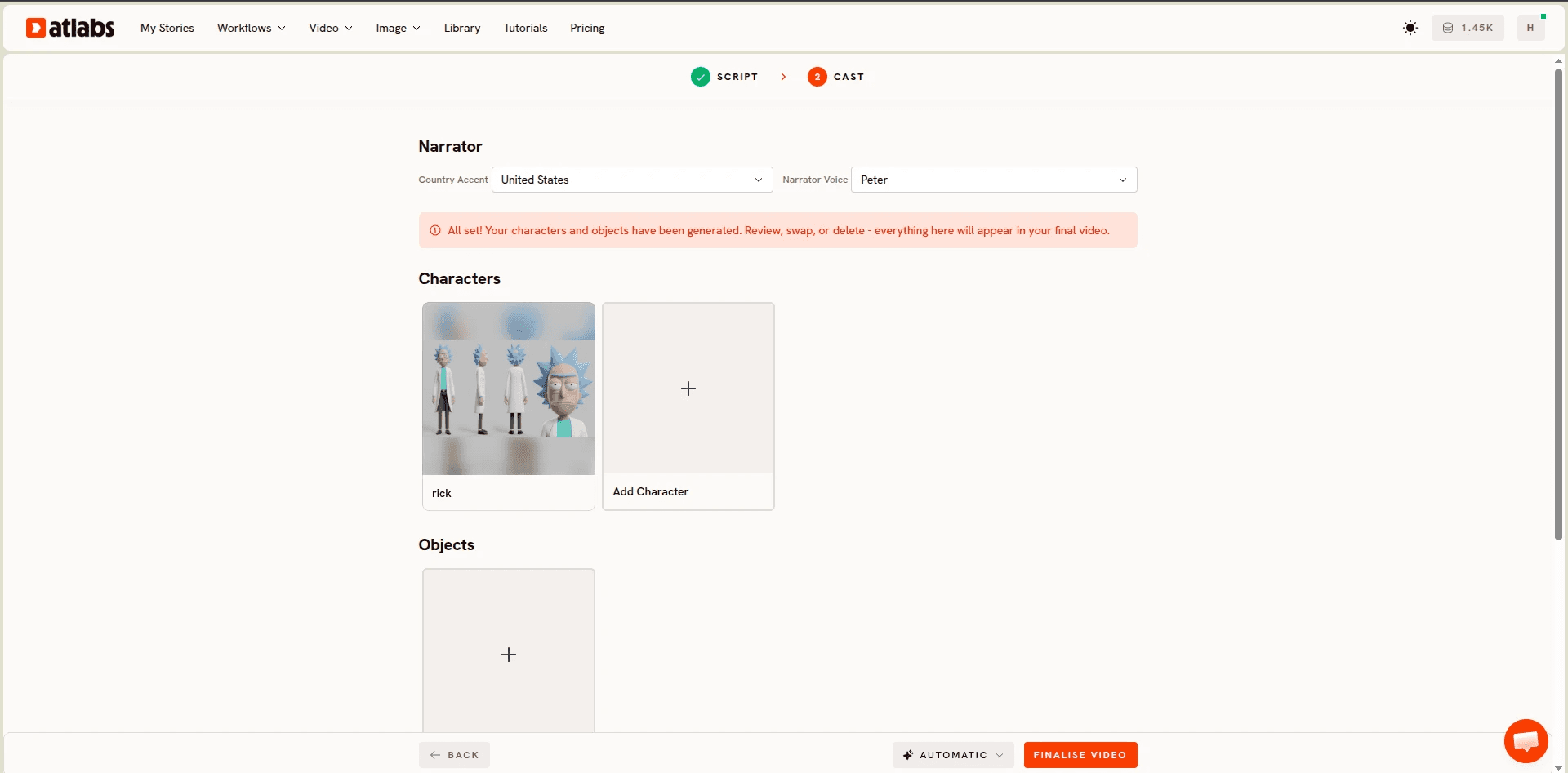
Use the Cast step in Atlabs to lock these. Add each character, define the appearance once, and the same face and outfit appear in every scene of this episode and in every future episode. Lock recurring objects and locations too, because in this genre the garage, the ship and the kitchen table are effectively characters themselves and their consistency sells the world.
For the vocal half, set your narrator voice and country accent in the same step, and give each character a distinct speech pattern in the script itself: one character interrupts, one over-explains, one speaks in short flat sentences. Written speech patterns survive generation better than tone notes do.
Keep a master character sheet alongside your scripts with proportions, color codes, typical expressions and speech tics. When a character returns in episode nine, reference the sheet identically rather than rewriting the description from memory.
Lock your cast and start generating
Step 4: Storyboard for Dialogue Rhythm, Not Spectacle
The camera grammar of dialogue-driven adult animation is deliberately unglamorous, and copying that restraint is what makes it feel authentic. Most of the runtime is medium two-shots holding on characters arguing. Cuts happen on lines rather than on action. Close-ups are saved for the moment a character says something genuinely damaging, which is why they land. Then, roughly once an episode, a sudden wide establishing shot of something enormous and strange, held for two or three seconds with no dialogue, which resets the scale and buys the next argument some room.
Storyboard each scene with: shot size, who is speaking, who is reacting, where the cut falls in the line, and how long the shot holds. The most valuable thing you can specify is the reaction shot, because in this genre the laugh usually belongs to whoever is not talking. Write it explicitly: "medium two-shot as character A explains the plan, cut to close-up on character B mid-sentence for the flat unimpressed reaction, hold one beat, cut back."
Also plan your silence. Dialogue-heavy comedy needs occasional dead air, the two-second hold where nobody says anything after an uncomfortable line. Generation will smooth over that gap unless you storyboard it with a duration.
Step 5: Generate, Review, and Iterate at the Scene Level
With the script locked, style trained, cast defined and storyboards planned, hit Finalise Video. Atlabs produces the full episode: scenes, animation, voices and pacing in one pass, up to 15 minutes.
Watch the first episode end to end with fresh eyes the next day, and review it in a specific order. Check dialogue timing first, because in this genre pacing problems kill an episode faster than visual ones. Then check character voices for consistency of personality across scenes. Then check the visual lock: same outlines, same silhouettes, same palette from scene two to scene fourteen. Note the specific scene numbers that miss.
Then iterate surgically. Scene level editing means you regenerate one scene without touching the rest. If the reaction close-up in scene seven fell flat, adjust that scene and regenerate scene seven alone. Everything else stays exactly as approved. For a dialogue-heavy format where timing tuning is most of post-production, this is the capability that makes solo production realistic.
Expect two or three passes per episode at the start, dropping to one or two by episode three as you learn how your writing reads in motion.
When the episode locks, run the Global Release Kit. Translate into 40+ languages with matching accents and subtitles, reframe your 16:9 master to 9:16 to cut clip promos for Shorts and Reels, and generate a thumbnail in one click. For adult animation specifically, that vertical reframe is your primary growth channel, since clipped exchanges travel far better than full episode links.
Watch The Full YouTube Tutorial
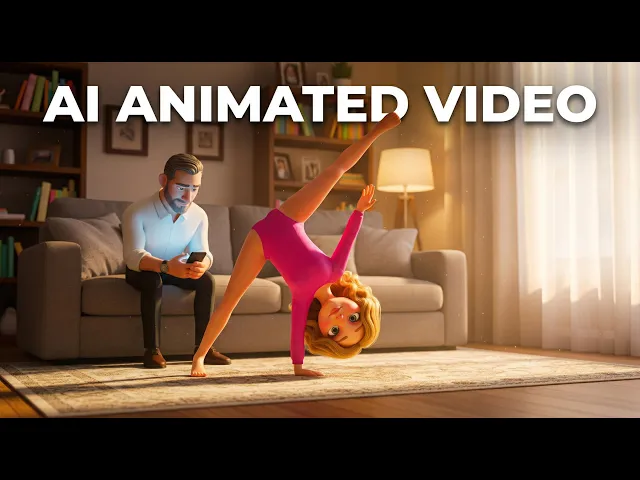
Want to see the complete workflow on screen first? This tutorial walks through the whole process end to end: pasting the script, choosing aspect ratio and animation style, casting characters, and finalising the video.
Try the workflow after watching
FAQ
Q1: How long does it take to make a Rick and Morty style episode with AI?
A ten to fifteen minute episode takes roughly three to five hours from script lock to export, and writing is the largest share of that. Your first episode runs longer while you dial in the flat 2D look and character voices. By episode five, production settles to two or three hours because the style is trained and the cast is locked, leaving writing as the only real variable.
Q2: How do I make a series in this style without infringing on Rick and Morty?
Take the technique, not the property. Flat 2D animation, sci-fi comedy premises, cynical dialogue and a dysfunctional family dynamic are general creative approaches nobody owns. What you cannot use are the specific characters, their names, designs, catchphrases, or story content owned by the show's rights holders. Build your own cast with their own silhouettes, names and neuroses. Original series also perform better, because the audience for this genre is unusually allergic to imitation.
Q3: Can I monetize adult animation on YouTube?
Yes, but the rules differ from kids content. Adult animation qualifies for monetization when it follows advertiser-friendly guidelines, and gratuitous profanity, graphic violence or sexual content will limit or demonetize an episode. Many creators in this genre run a lighter cut for YouTube and keep the unfiltered version behind Patreon or a membership tier. Plan which version you are making before you write, because it affects the script, not just the edit.
Q4: What if my characters keep drifting between episodes?
That is the single most common failure in a long-running series, and it has two fixes. Use the Cast step to lock each character once, so the same face and outfit carry into every future episode. And train a custom style so the linework, palette and rendering approach are locked at the style level rather than being re-described each time. Between those two, drift becomes very difficult.
Q5: Why does my output look too polished or too 3D?
Your style description is probably too aesthetic and not physical enough. Replace "cartoon style" with construction terms: "flat vector shapes, uniform thin black outlines, zero gradients, no soft shading, simple oval heads with tubular limbs, plain white circular eyes." The flatness has to be stated as an instruction, because most video models drift toward dimensional rendering by default.
Q6: Can I blend AI generation with Premiere or DaVinci?
Yes. Many creators generate scenes in Atlabs and then handle sound design, music and final timing in Adobe Premiere Pro or DaVinci Resolve. For dialogue comedy the external pass is often worth it, because trimming a few frames off a reaction can meaningfully change whether a joke lands. Atlabs exports at standard resolutions that drop into any professional editor.
Q7: Can I release the series in other languages?
Yes. Atlabs translates into 40+ languages with matching accents and subtitles from the same production. Be aware that dialogue-driven comedy translates less cleanly than visual comedy does, since wordplay and rhythm carry much of the humor, so budget a review pass on your primary secondary language rather than shipping every version unchecked.
From Concept to Series: Real Production Workflow
Creators who sustain an adult animation series treat it as a writing operation with a production pipeline attached, not the other way around. The animation is the cheap part now. The writing is the moat.
Week 1: Write three episode premises as single sentences, then draft all three scripts. Lock character designs and silhouettes. Build a reference board for the flat 2D look. Twelve to eighteen hours, most of it writing.
Week 2: Train your custom style on sample frames. Generate two or three test scenes to confirm the flatness, linework and palette are holding. Refine and retest. Five to eight hours.
Week 3: Generate your first full episode. Four to six hours including iteration while you learn how your dialogue timing translates to screen.
Week 4: Generate episodes two and three. Three to four hours each with the style trained and cast locked.
Months 2 to 3: Hold a weekly or biweekly cadence, and stay two or three scripts ahead at all times. Writing is your bottleneck, so protect the buffer.
Your Animation Series Starts Today
Making a Rick and Morty style animated series in 2026 no longer needs a studio, a storyboard department or a nine-month production cycle. Solo writers are shipping adult animation because the production barrier collapsed and the remaining barrier is the one that always mattered: whether the writing is funny.
The workflow is proven. A premise that works in one sentence. A flat 2D style trained once and inherited by every episode. A locked cast with distinct silhouettes and speech patterns. Storyboards built around dialogue rhythm. Iteration at the scene level so a timing fix costs minutes rather than a re-render.
Your first episode is proof of concept. Your third is your system. By your fifth you are a show.