Features
Workflows
Solutions
Resources
BACK

How to Make Peppa Pig Style 2D Cartoon Series with AI in 2026

How to Make Peppa Pig Style 2D Cartoon Series with AI in 2026

How to Make Peppa Pig Style 2D Cartoon Series with AI in 2026

Peppa Pig's genius lies in simplicity. A pig family, a simple 2D aesthetic, relatable scenarios, and sharp dialogue. The show generates billions in revenue globally because it works. Yet producing it requires coordinated animation studios, voice acting teams, and months of post-production. Until now, the barrier to entry has been insurmountable for independent creators.

In 2026, AI animation has evolved to the point where you can generate Peppa Pig-quality 2D animated series episodes in days, not months. The key is understanding which AI workflows replicate that specific aesthetic: clean 2D animation, consistent character design, varied backgrounds, and perfectly synced dialogue across multiple characters.

This guide walks you through the entire process. By the end, you'll know how to produce a full animated series episode using Atlabs' AI video and animation capabilities. More importantly, you'll understand how to maintain the visual consistency and storytelling rhythm that makes shows like Peppa Pig addictive to young audiences.

How to Make Peppa Pig Style 2D Cartoon Series with AI in 2026 ## SEO Metadata Target Keyword: How to make Peppa Pig style cartoons AI 2026 Secondary Keywords: 2D animation AI, cartoon series AI, how to create animated series, animated children's show Meta Title: Make Peppa Pig Style 2D Cartoons with AI in 2026 Meta Description: Learn how to create Peppa Pig-style 2D animated cartoon series using AI. Complete guide to animated series production with Atlabs in 2026. URL Slug: how-to-make-peppa-pig-style-cartoons-ai-2026 --- ## Hook Peppa Pig's genius lies in simplicity. A pig family, a simple 2D aesthetic, relatable scenarios, and sharp dialogue. The show generates billions in revenue globally because it works. Yet producing it requires coordinated animation studios, voice acting teams, and months of post-production. Until now, the barrier to entry has been insurmountable for independent creators. In 2026, AI animation has evolved to the point where you can generate Peppa Pig-quality 2D animated series episodes in days, not months. The key is understanding which AI workflows replicate that specific aesthetic: clean 2D animation, consistent character design, varied backgrounds, and perfectly synced dialogue across multiple characters. This guide walks you through the entire process. By the end, you'll know how to produce a full animated series episode using Atlabs' AI video and animation capabilities. More importantly, you'll understand how to maintain the visual consistency and storytelling rhythm that makes shows like Peppa Pig addictive to young audiences. **Ready to start?** Try Atlabs free and explore the Animated Video workflow: https://app.atlabs.ai/app --- ## Why This Matters for Animated Series Creators For decades, creating an animated series required either venture capital, a studio deal, or years of self-teaching animation software. Bedroom animators existed, but they produced low-fidelity content because manual frame-by-frame animation demanded thousands of hours. Multi-character lip sync and consistent character generation change that equation fundamentally. When an AI can generate the same character in multiple poses with perfectly synchronized dialogue across scenes, the production timeline collapses from months to weeks. When scene composition happens automatically, you're not spending 40 percent of your time managing camera angles and framing. Reddit conversations and creator forums consistently show the same frustration: passion for storytelling, zero ability to produce animation at professional quality without hiring teams. Parents, educators, and content creators see market opportunity in 2D animated series but lack the production infrastructure. AI removes that barrier if you understand the right workflow. --- ## The Atlabs Workflow for Peppa Pig-Style 2D Cartoons Atlabs provides specialized workflows for 2D animation series production. The **Animated Video workflow** creates stylized, character-driven animation perfect for narrative shows. The **Lip Sync app** handles multi-character dialogue synchronization. Together with **Script to Video** for narrative structure, these create the complete studio pipeline for series production. Here's why this stack works: the Animated Video engine generates consistent character animation across scenes, meaning your protagonist looks identical in Episode 1 and Episode 5. Lip Sync ensures that when multiple characters speak, only the speaking character's mouth moves. Script to Video lets you structure full narrative arcs with scene-by-scene breakdown. Previously, each of these required separate tools and manual integration. The aesthetic match is critical. Peppa Pig uses a flat 2D visual style with rounded shapes, bold outlines, and simple environments. Atlabs' 2D animation models (particularly when routed through specific style prompts) produce exactly this aesthetic. You're not fighting the AI's natural output; you're working with it. **Start exploring now:** Open the Animated Video workflow at https://app.atlabs.ai/app and begin testing. --- ## Step-by-Step: Create Your First Peppa Pig-Style Episode ### Step 1: Write Your Script (Screenplay Format) Start with a complete screenplay. Peppa Pig episodes are typically 5 minutes, but you can produce shorter formats for YouTube or TikTok. Your screenplay should follow standard TV animation formatting: ACT 1 (Intro): Establish location and introduce the problem ACT 2 (Rising Action): Characters interact, conflict develops ACT 3 (Resolution): Problem solved, lesson learned Example structure for a 3-minute episode: SCENE 1: INT. LIVING ROOM. MORNING. PEPPA sits on the sofa watching TV. DADDY PIG enters. DADDY PIG: Peppa, would you like to go to the aquarium today? PEPPA: Yes please, Daddy! Write clear dialogue, specific locations, and character actions. Atlabs uses this screenplay format to generate scene composition, character interactions, and dialogue timing automatically. ### Step 2: Prepare Your Character Descriptions Before generating video, define your characters precisely. This is where consistency lives. Create a character sheet for each main character with: Name, species/type, clothing (specific colors and patterns), personality traits, voice characteristics (if using text-to-speech), and any distinctive features. Example: PEPPA PIG: Pink pig, wears a pink dress with a pearl necklace, red shoes. Round face, cheerful personality, often giggling. Voice: British accent, playful, slightly cheeky tone. DADDY PIG: Larger brown pig, wears a navy sweater and white shirt. Round spectacles. Patient, thoughtful, sometimes silly. Voice: British accent, warm, fatherly. Save these descriptions—you'll use them consistently across every episode. ### Step 3: Choose Your Animation Style and Aspect Ratio Go to the **Animated Video workflow** (https://app.atlabs.ai/app and navigate to Workflows > Animated Video). For Peppa Pig style, your visual style must be "2D Cartoon" or "Flat 2D Modern." These produce the signature clean lines, rounded shapes, and simple color palettes that define the show. Avoid 3D, anime, or photorealistic styles. Select aspect ratio based on your distribution channel: - 16:9 for YouTube - 9:16 for vertical social (TikTok, Instagram Reels) - 1:1 for square social formats For series production, consistency in aspect ratio across all episodes matters tremendously. Choose one and stick with it throughout your season. ### Step 4: Upload or Describe Your Creative Direction Provide a detailed creative direction that locks the visual universe: "Bright, cheerful household setting. Peppa Pig's living room has warm pastel colors: yellow walls, red furniture, simple rounded shapes throughout. Windows with outdoor views. Toys scattered around to show a lived-in home. All characters are flat 2D cartoon animals with simple features, big expressive eyes, and rounded bodies. No shadows or complex gradients. Color palette: primary colors, pastels, high contrast. Lighting: bright, evenly distributed, no dramatic shadows." This description ensures Episode 1, 10, and 50 all look visually cohesive. The more specific you are about colors, shapes, and lighting, the more consistent your output. ### Step 5: Generate the Video Submit your screenplay and creative direction. Atlabs' Animated Video engine will: 1. Parse your screenplay for scenes and characters 2. Generate consistent character animations across all scenes 3. Compose varied framing (closeups, medium shots, wide shots) 4. Produce dialogue-ready video with character mouth movements prepared for sync Generation time typically ranges from 10 to 20 minutes for a 3 to 5-minute episode depending on complexity and queue time. ### Step 6: Apply Multi-Character Lip Sync Once your animation generates, upload it to the **Lip Sync app** (https://app.atlabs.ai/lip-sync) along with your final audio track (voice actors, sound effects, music). Atlabs' multi-character lip sync technology analyzes the audio to identify which character is speaking at each moment and synchronizes only that character's mouth movements. This eliminates the artificial "everyone talking at once" look that plagues amateur animation. Result: natural-looking dialogue exchanges between Peppa, Daddy Pig, Mummy Pig, and all supporting characters in a single pass. What traditionally took weeks of manual animation work now takes minutes. ### Step 7: Add Caption Video for Accessibility and Engagement Use the **Caption Video app** (available within Atlabs workflows) to auto-generate captions synchronized to dialogue. This serves two purposes: 1. Accessibility for hearing-impaired viewers 2. Improved engagement on platforms like TikTok and Instagram (captions increase watch time by 40+ percent) Peppa Pig's audience often includes non-native English speakers. Captions multiply your global reach instantly. --- ## Why Atlabs Works Well for Peppa Pig-Style Series Production Three specific advantages make Atlabs the right platform for this use case. First, the Animated Video workflow's multi-character animation ensures character consistency across episodes. Peppa must look identical in Episode 1 and Episode 52. Manual animation requires tedious character model management. Atlabs generates from descriptions, so consistent input produces consistent output. Your character sheets become your production guarantee. Second, multi-character lip sync eliminates the production bottleneck of dialogue scenes. Traditional animation requires voice recording first, then animating mouth movements to match. This takes weeks. Atlabs does this in one pass. A scene with four characters having a conversation (Peppa, Daddy, Mummy, Suzy Sheep) generates with all mouths synchronized correctly without additional work. Third, the Kids Performance Teaching Character feature opens educational series opportunities beyond pure entertainment. If you're building a learning-focused animated series (phonics, science concepts, social skills), you can feature a presenter character with synchronized lip movement while animated characters interact. This hybrid approach (real presenter plus animated characters) is powerful for educational content and performs exceptionally well on YouTube. --- ## Example Prompts for Peppa Pig-Style 2D Cartoons These prompts are tested and ready to use. Copy directly into the Animated Video workflow and generate full scenes. ### Prompt 1: Family Breakfast Scene A cheerful kitchen scene with pastel yellow walls and simple wooden furniture. PEPPA PIG sits at a round table with DADDY PIG, MUMMY PIG, and her brother GEORGE. They're eating cereal. The table has bowls, spoons, and glasses. A window shows a bright sunny day outside. All characters are flat 2D cartoon pigs with simple features: round bodies, big eyes, small snouts. Peppa wears her pink dress. Daddy wears his navy sweater. Mummy wears her blue dress. George wears his blue shirt. The room is warm and homey. Camera work includes a wide shot of the family, then closeups of each character's face as they interact. The mood is wholesome, funny, and relatable. The animation style is clean 2D with bold outlines and no shadows. **Try this prompt in Atlabs Animated Video workflow:** https://app.atlabs.ai/app ### Prompt 2: Peppa and Friends at Playgroup A bright playgroup setting with pastel walls (mint green and soft yellow), low tables with toys, colorful mats on the floor. PEPPA PIG and SUZY SHEEP sit at a table building with toy blocks. MADAME GAZELLE, the playgroup teacher (a tall gazelle wearing a light purple dress), watches them play. Other animals sit in the background playing with toys. All characters are flat 2D cartoon style with simple features and solid colors. The room is filled with natural light from large windows. Toys include blocks, balls, and picture books. Camera angles: wide shot of the whole playgroup, medium shots of Peppa and Suzy together, and closeups of their hands building with blocks. The mood is cheerful, educational, and encouraging. Animation style: clean 2D, no gradients, bright primary and pastel colors. **Try this prompt in Atlabs Animated Video workflow:** https://app.atlabs.ai/app ### Prompt 3: Muddy Puddles Scene An outdoor park setting with green grass, several large mud puddles in the center, and gray clouds above (suggesting recent rain). PEPPA and GEORGE in rain boots (Peppa's red, George's red) jump and splash in the puddles repeatedly, laughing. DADDY PIG and MUMMY PIG stand on the dry grass watching and smiling. Simple trees in the background. The ground has puddles reflecting the sky. All characters are flat 2D cartoon pigs. Peppa's pink dress and George's blue shirt show mud splashes. The scene has bright but slightly overcast lighting. Camera work: wide shot of the park, closeups of splashing water and the children's joyful faces, medium shots of the parents watching. Animation style: simple 2D with bold outlines, no complex effects. Mood: playful, joyful, and full of childlike wonder. **Try this prompt in Atlabs Animated Video workflow:** https://app.atlabs.ai/app ### Prompt 4: Bedtime Routine A cozy bedroom with soft blue walls, a single bed with a colorful quilt, a bedside table with a nightlight, and a bookshelf with picture books. PEPPA PIG is already in bed. DADDY PIG sits on the edge of the bed reading from a storybook to Peppa. A small window shows the moon and stars outside. The room has warm, dimmed lighting. Stuffed animals sit on the shelf. All characters are flat 2D cartoons. Daddy wears his navy sweater. The room feels safe and calm. Camera work includes a wide shot of the whole room, a closeup of Peppa in bed listening attentively, and a medium shot of Daddy reading. The mood is calm, gentle, and loving. Animation style: simple 2D with soft colors and no harsh shadows. **Try this prompt in Atlabs Animated Video workflow:** https://app.atlabs.ai/app ### Prompt 5: Rainy Day Indoors with Play A colorful living room with yellow walls, red sofa, and a rain-gray window showing heavy rain outside. PEPPA and GEORGE sit on the floor building a blanket fort using the sofa cushions, while MUMMY PIG brings them juice boxes and biscuits. DADDY PIG sits nearby reading a newspaper. The scene shows toys scattered around: blocks, a toy house, picture books. All characters are flat 2D cartoon pigs. Peppa wears her pink dress and George his blue shirt. The lighting is warm and cozy indoors, contrasting with the gray rain outside. Camera work: wide shot of the family scene, closeup of the children building, medium shot of Mummy bringing snacks. The mood is cozy, content, and indoor-play-happy. Animation style: clean 2D with bold outlines, warm colors. **Try this prompt in Atlabs Animated Video workflow:** https://app.atlabs.ai/app ### Prompt 6: School Learning Scene A bright classroom with soft green walls, a whiteboard with simple drawn shapes, small desks and chairs, and windows showing a sunny day. MS RABBIT, the teacher (tall rabbit with long ears, wearing glasses and a light pink dress), points to shapes on the board while five young animal students sit and watch. PEPPA raises her hand. SUZY SHEEP, DANNY DOG, REBECCA RABBIT, and PEDRO PONY are visible. The room is cheerful and child-safe. All characters are flat 2D cartoon style. The classroom has books on shelves and colorful posters. Lighting is bright and educational. Camera work: wide shot of the classroom, closeup of the teacher pointing, medium shots of students' reactions. The mood is educational, engaging, and encouraging. Animation style: simple 2D with no complex effects. **Try this prompt in Atlabs Animated Video workflow:** https://app.atlabs.ai/app --- ## Pro Tips for Maximum Series Consistency **Lock your character descriptions early.** Every episode from now on should reference the exact same character sheet. The more specific (include hex color codes if possible: #FF69B4 for Peppa's pink), the more consistent your AI output. Consistency is what makes a series feel "real." **Maintain location library.** Create 5 to 10 key locations (living room, kitchen, school, park, beach, town square) and reuse them across episodes. Variation within a consistent visual language is what audiences expect. Peppa's living room should look identical in Episode 1 and Episode 30. **Test episode formats.** Peppa Pig episodes follow a strict 5-minute format: intro, problem, escalation, resolution, moral. But your series might work better at 3 minutes (social media), 10 minutes (YouTube), or 15 minutes (streaming). Experiment with format early; it affects everything downstream. **Voice acting matters enormously.** Use the same voice actors for each character across all episodes. Peppa's voice must be instantly recognizable. This is the one area where consistency cannot come from AI alone; invest in voice talent. **Batch production workflow.** Don't make one episode at a time. Write 5 to 10 scripts, generate all animations, record all voice acting, then apply lip sync in batch. This workflow is 30 percent more efficient than serial production. --- ## Frequently Asked Questions **How long does each episode take to produce?** A 3 to 5-minute episode takes roughly 2 to 3 hours from script to final video (including animation generation and lip sync). This does not include voice recording or sound design, which happen in parallel. Total production time per episode including voice work is typically 5 to 8 hours from concept to final export. **Can I use music and sound effects with the Peppa Pig style?** Yes. Peppa Pig uses orchestral background music and minimal sound effects (footsteps, splashes, giggles). Generate your animation first, then add audio in post-production. Atlabs' workflow supports background music and sound layering. **What if my generated characters look slightly different between episodes?** This is rare if your character descriptions are detailed. But if inconsistencies occur, use the Modify Video app (https://app.atlabs.ai/modify-video) to adjust a character's appearance in specific scenes, or regenerate those scenes with refined descriptions. The key is specificity in your character sheet from the beginning. **Can I monetize a series made with Atlabs?** Yes. You own the content you generate. Publish to YouTube, TikTok, streaming platforms—all are allowed. Be transparent about AI generation if required by platform (YouTube requires disclosure for AI-generated content in some regions). Monetization policies vary by platform, so check each one's terms. **What about copyright and licensing?** Atlabs-generated content is yours to use commercially. However, avoid copying Peppa Pig's actual character designs—that's copyright infringement. Create your own characters (different pig style, different name, different universe). The "Peppa Pig style" means the format and storytelling approach, not the specific IP. **How do I handle multiple episodes efficiently?** Create a production template: one master character sheet, one location library, one approved visual direction document. Generate 5 scripts. Generate all animations in parallel using the same character descriptions. Record all voice in one session. Apply lip sync to all episodes batch-wise. This reduces per-episode production time by 40 percent compared to serial workflows. --- ## Final Verdict Producing a Peppa Pig-quality 2D animated series is no longer restricted to studios. Multi-character lip sync, consistent character animation, and automated scene composition make it possible for solo creators to produce broadcast-quality episodes in 2 to 3 hours. The specific combination of the Animated Video workflow (for consistent 2D character animation), the Lip Sync app (for multi-character dialogue synchronization), and the Script to Video workflow (for narrative structure) removes the three biggest production barriers: animation time, consistency management, and dialogue synchronization. Whether you're building an educational series, an entertainment show, or a creator-driven animated universe, Atlabs provides the complete production stack. Start with a single episode. Test your character descriptions. Refine your visual direction based on results. Then scale to a full season. The barrier that once required six-figure budgets and coordinated teams now requires only creativity, writing, and voice talent. The production infrastructure is here. **Ready to start?** Begin with the Animated Video workflow at https://app.atlabs.ai/app **Want to explore all workflows?** Visit https://www.atlabs.ai/ and try Atlabs free. **Need guidance on script writing?** Use the AI Script Writer feature within Atlabs' Script to Video workflow at https://app.atlabs.ai/app **Questions about multi-character scenes?** Test the Lip Sync app directly at https://app.atlabs.ai/lip-sync **Start your series today:** https://www.atlabs.ai/

Why This Matters for Animated Series Creators

For decades, creating an animated series required either venture capital, a studio deal, or years of self-teaching animation software. Bedroom animators existed, but they produced low-fidelity content because manual frame-by-frame animation demanded thousands of hours.

Multi-character lip sync and consistent character generation change that equation fundamentally. When an AI can generate the same character in multiple poses with perfectly synchronized dialogue across scenes, the production timeline collapses from months to weeks. When scene composition happens automatically, you're not spending 40 percent of your time managing camera angles and framing.

Reddit conversations and creator forums consistently show the same frustration: passion for storytelling, zero ability to produce animation at professional quality without hiring teams. Parents, educators, and content creators see market opportunity in 2D animated series but lack the production infrastructure. AI removes that barrier if you understand the right workflow.

The Atlabs Workflow for Peppa Pig-Style 2D Cartoons

Atlabs provides specialized workflows for 2D animation series production. The Animated Video workflow creates stylized, character-driven animation perfect for narrative shows. The Lip Sync app handles multi-character dialogue synchronization. Together with Script to Video for narrative structure, these create the complete studio pipeline for series production.

Here's why this stack works: the Animated Video engine generates consistent character animation across scenes, meaning your protagonist looks identical in Episode 1 and Episode 5. Lip Sync ensures that when multiple characters speak, only the speaking character's mouth moves. Script to Video lets you structure full narrative arcs with scene-by-scene breakdown. Previously, each of these required separate tools and manual integration.

The aesthetic match is critical. Peppa Pig uses a flat 2D visual style with rounded shapes, bold outlines, and simple environments. Atlabs' 2D animation models (particularly when routed through specific style prompts) produce exactly this aesthetic. You're not fighting the AI's natural output; you're working with it.

Step-by-Step: Create Your First Peppa Pig-Style Episode

Step 1: Write Your Script (Screenplay Format)
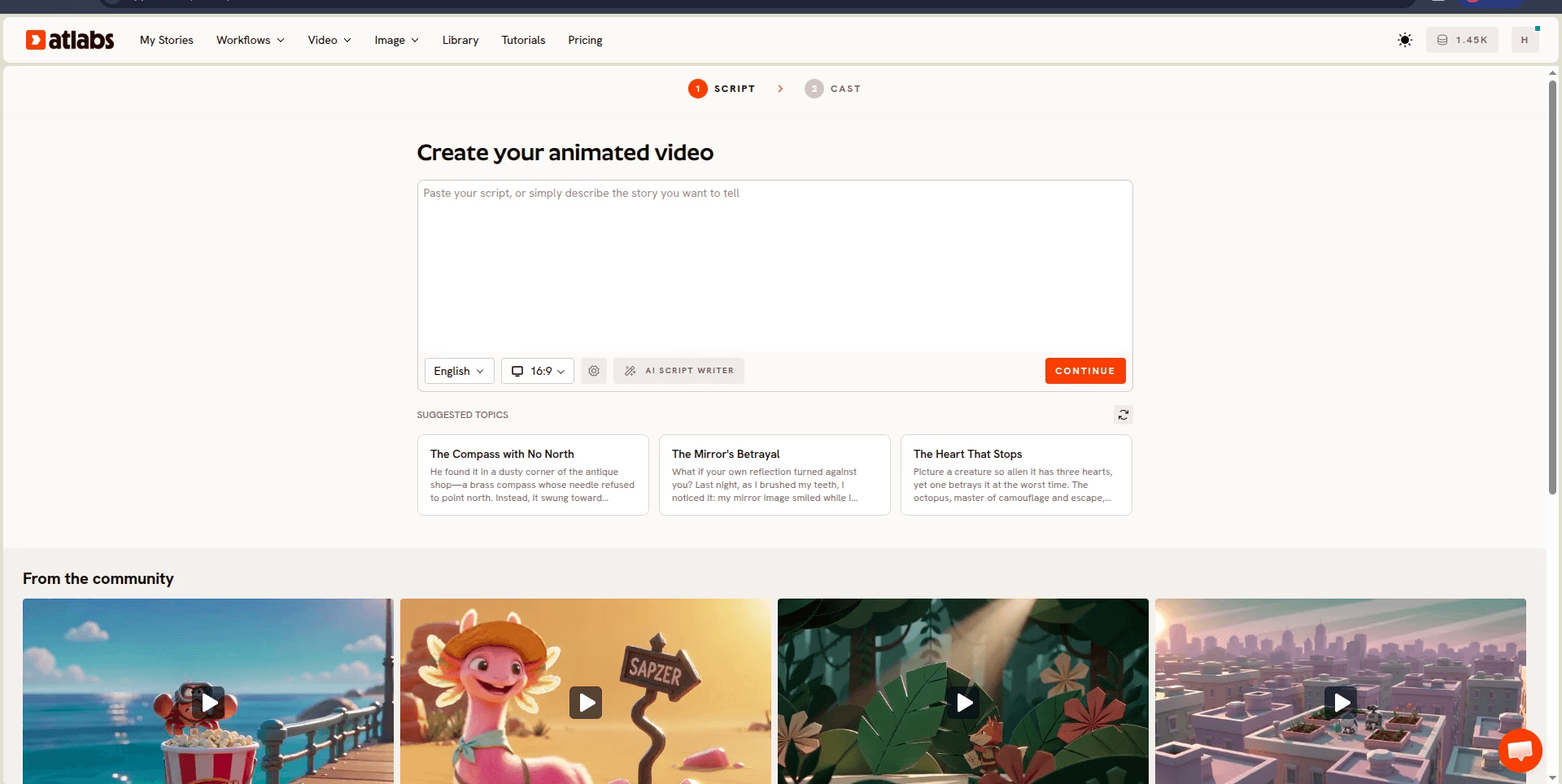
Start with a complete screenplay. Peppa Pig episodes are typically 5 minutes, but you can produce shorter formats for YouTube or TikTok. Your screenplay should follow standard TV animation formatting:

ACT 1 (Intro): Establish location and introduce the problem
ACT 2 (Rising Action): Characters interact, conflict develops
ACT 3 (Resolution): Problem solved, lesson learned

Example structure for a 3-minute episode:

SCENE 1: INT. LIVING ROOM. MORNING.

PEPPA sits on the sofa watching TV. DADDY PIG enters.

DADDY PIG: Peppa, would you like to go to the aquarium today?

PEPPA: Yes please, Daddy!

Write clear dialogue, specific locations, and character actions. Atlabs uses this screenplay format to generate scene composition, character interactions, and dialogue timing automatically.

Step 2: Prepare Your Character Descriptions
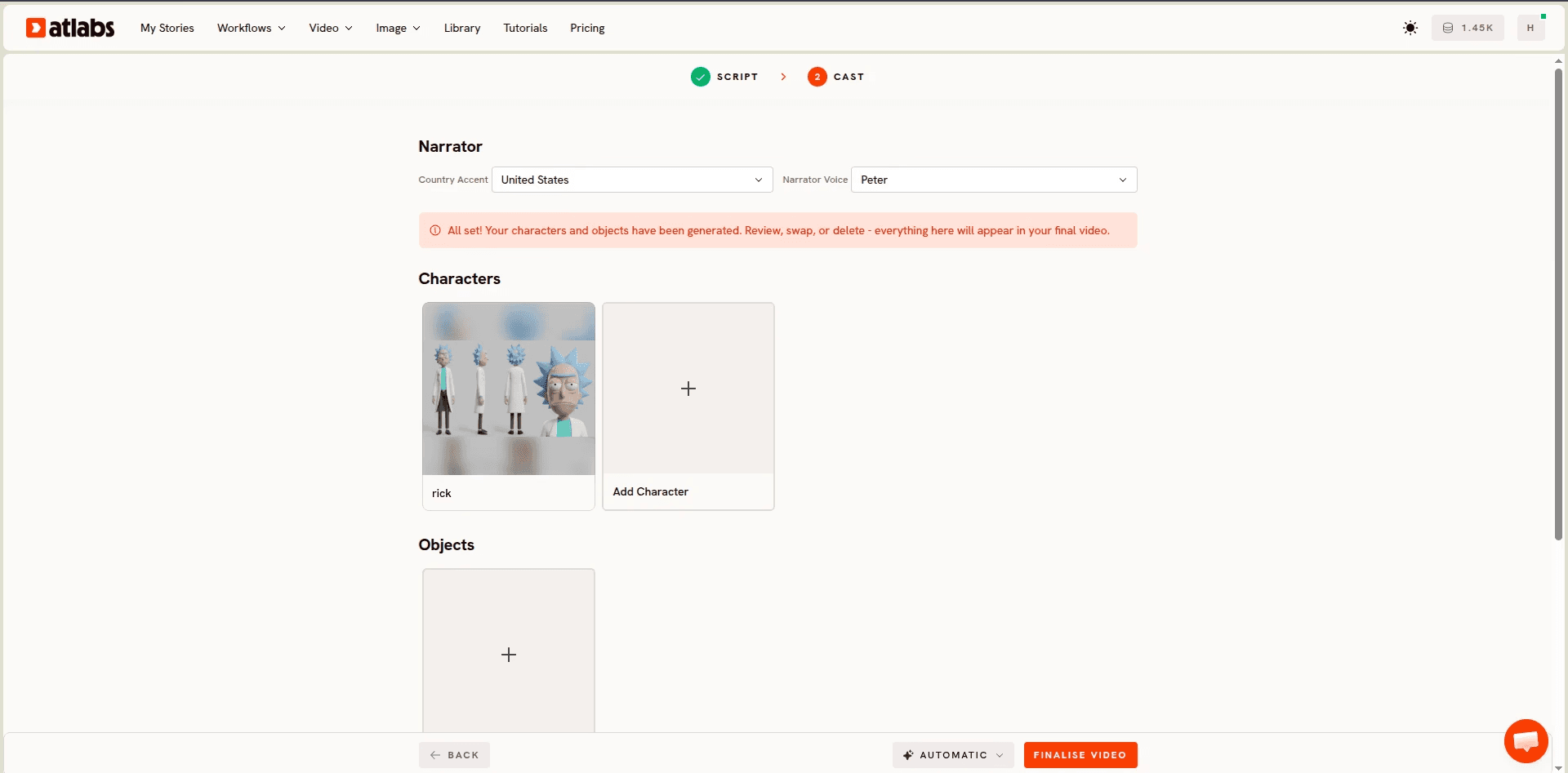
Before generating video, define your characters precisely. This is where consistency lives. Create a character sheet for each main character with:

Name, species/type, clothing (specific colors and patterns), personality traits, voice characteristics (if using text-to-speech), and any distinctive features.

Example:

PEPPA PIG: Pink pig, wears a pink dress with a pearl necklace, red shoes. Round face, cheerful personality, often giggling. Voice: British accent, playful, slightly cheeky tone.

DADDY PIG: Larger brown pig, wears a navy sweater and white shirt. Round spectacles. Patient, thoughtful, sometimes silly. Voice: British accent, warm, fatherly.

Save these descriptions—you'll use them consistently across every episode.

Step 3: Choose Your Animation Style and Aspect Ratio

Go to the Animated Video workflow (https://app.atlabs.ai/app and navigate to Workflows > Animated Video).

For Peppa Pig style, your visual style must be "2D Cartoon" or "Flat 2D Modern." These produce the signature clean lines, rounded shapes, and simple color palettes that define the show. Avoid 3D, anime, or photorealistic styles.

Select aspect ratio based on your distribution channel:

  • 16:9 for YouTube

  • 9:16 for vertical social (TikTok, Instagram Reels)

  • 1:1 for square social formats

For series production, consistency in aspect ratio across all episodes matters tremendously. Choose one and stick with it throughout your season.

Step 4: Upload or Describe Your Creative Direction

Provide a detailed creative direction that locks the visual universe:

"Bright, cheerful household setting. Peppa Pig's living room has warm pastel colors: yellow walls, red furniture, simple rounded shapes throughout. Windows with outdoor views. Toys scattered around to show a lived-in home. All characters are flat 2D cartoon animals with simple features, big expressive eyes, and rounded bodies. No shadows or complex gradients. Color palette: primary colors, pastels, high contrast. Lighting: bright, evenly distributed, no dramatic shadows."

This description ensures Episode 1, 10, and 50 all look visually cohesive. The more specific you are about colors, shapes, and lighting, the more consistent your output.

Step 5: Generate the Video

Submit your screenplay and creative direction. Atlabs' Animated Video engine will:

  1. Parse your screenplay for scenes and characters

  2. Generate consistent character animations across all scenes

  3. Compose varied framing (closeups, medium shots, wide shots)

  4. Produce dialogue-ready video with character mouth movements prepared for sync

Generation time typically ranges from 10 to 20 minutes for a 3 to 5-minute episode depending on complexity and queue time.

Step 6: Apply Multi-Character Lip Sync

Once your animation generates, upload it to the Lip Sync app (https://app.atlabs.ai/lip-sync) along with your final audio track (voice actors, sound effects, music).

Atlabs' multi-character lip sync technology analyzes the audio to identify which character is speaking at each moment and synchronizes only that character's mouth movements. This eliminates the artificial "everyone talking at once" look that plagues amateur animation.

Result: natural-looking dialogue exchanges between Peppa, Daddy Pig, Mummy Pig, and all supporting characters in a single pass. What traditionally took weeks of manual animation work now takes minutes.

Step 7: Add Caption Video for Accessibility and Engagement

Use the Caption Video app (available within Atlabs workflows) to auto-generate captions synchronized to dialogue. This serves two purposes:

  1. Accessibility for hearing-impaired viewers

  2. Improved engagement on platforms like TikTok and Instagram (captions increase watch time by 40+ percent)

Peppa Pig's audience often includes non-native English speakers. Captions multiply your global reach instantly.

Why Atlabs Works Well for Peppa Pig-Style Series Production

Three specific advantages make Atlabs the right platform for this use case.

First, the Animated Video workflow's multi-character animation ensures character consistency across episodes. Peppa must look identical in Episode 1 and Episode 52. Manual animation requires tedious character model management. Atlabs generates from descriptions, so consistent input produces consistent output. Your character sheets become your production guarantee.

Second, multi-character lip sync eliminates the production bottleneck of dialogue scenes. Traditional animation requires voice recording first, then animating mouth movements to match. This takes weeks. Atlabs does this in one pass. A scene with four characters having a conversation (Peppa, Daddy, Mummy, Suzy Sheep) generates with all mouths synchronized correctly without additional work.

Third, the Kids Performance Teaching Character feature opens educational series opportunities beyond pure entertainment. If you're building a learning-focused animated series (phonics, science concepts, social skills), you can feature a presenter character with synchronized lip movement while animated characters interact. This hybrid approach (real presenter plus animated characters) is powerful for educational content and performs exceptionally well on YouTube.


Example Prompts for Peppa Pig-Style 2D Cartoons

These prompts are tested and ready to use. Copy directly into the Animated Video workflow and generate full scenes.

Prompt 1: Family Breakfast Scene

A cheerful kitchen scene with pastel yellow walls and simple wooden furniture. PEPPA PIG sits at a round table with DADDY PIG, MUMMY PIG, and her brother GEORGE. They're eating cereal. The table has bowls, spoons, and glasses. A window shows a bright sunny day outside. All characters are flat 2D cartoon pigs with simple features: round bodies, big eyes, small snouts. Peppa wears her pink dress. Daddy wears his navy sweater. Mummy wears her blue dress. George wears his blue shirt. The room is warm and homey. Camera work includes a wide shot of the family, then closeups of each character's face as they interact. The mood is wholesome, funny, and relatable. The animation style is clean 2D with bold outlines and no shadows.

Try this prompt in Atlabs Animated Video workflow: https://app.atlabs.ai/app

Prompt 2: Peppa and Friends at Playgroup

A bright playgroup setting with pastel walls (mint green and soft yellow), low tables with toys, colorful mats on the floor. PEPPA PIG and SUZY SHEEP sit at a table building with toy blocks. MADAME GAZELLE, the playgroup teacher (a tall gazelle wearing a light purple dress), watches them play. Other animals sit in the background playing with toys. All characters are flat 2D cartoon style with simple features and solid colors. The room is filled with natural light from large windows. Toys include blocks, balls, and picture books. Camera angles: wide shot of the whole playgroup, medium shots of Peppa and Suzy together, and closeups of their hands building with blocks. The mood is cheerful, educational, and encouraging. Animation style: clean 2D, no gradients, bright primary and pastel colors.

Try this prompt in Atlabs Animated Video workflow: https://app.atlabs.ai/app

Prompt 3: Muddy Puddles Scene

An outdoor park setting with green grass, several large mud puddles in the center, and gray clouds above (suggesting recent rain). PEPPA and GEORGE in rain boots (Peppa's red, George's red) jump and splash in the puddles repeatedly, laughing. DADDY PIG and MUMMY PIG stand on the dry grass watching and smiling. Simple trees in the background. The ground has puddles reflecting the sky. All characters are flat 2D cartoon pigs. Peppa's pink dress and George's blue shirt show mud splashes. The scene has bright but slightly overcast lighting. Camera work: wide shot of the park, closeups of splashing water and the children's joyful faces, medium shots of the parents watching. Animation style: simple 2D with bold outlines, no complex effects. Mood: playful, joyful, and full of childlike wonder.

Try this prompt in Atlabs Animated Video workflow: https://app.atlabs.ai/app

Prompt 4: Bedtime Routine

A cozy bedroom with soft blue walls, a single bed with a colorful quilt, a bedside table with a nightlight, and a bookshelf with picture books. PEPPA PIG is already in bed. DADDY PIG sits on the edge of the bed reading from a storybook to Peppa. A small window shows the moon and stars outside. The room has warm, dimmed lighting. Stuffed animals sit on the shelf. All characters are flat 2D cartoons. Daddy wears his navy sweater. The room feels safe and calm. Camera work includes a wide shot of the whole room, a closeup of Peppa in bed listening attentively, and a medium shot of Daddy reading. The mood is calm, gentle, and loving. Animation style: simple 2D with soft colors and no harsh shadows.

Try this prompt in Atlabs Animated Video workflow: https://app.atlabs.ai/app

Prompt 5: Rainy Day Indoors with Play

A colorful living room with yellow walls, red sofa, and a rain-gray window showing heavy rain outside. PEPPA and GEORGE sit on the floor building a blanket fort using the sofa cushions, while MUMMY PIG brings them juice boxes and biscuits. DADDY PIG sits nearby reading a newspaper. The scene shows toys scattered around: blocks, a toy house, picture books. All characters are flat 2D cartoon pigs. Peppa wears her pink dress and George his blue shirt. The lighting is warm and cozy indoors, contrasting with the gray rain outside. Camera work: wide shot of the family scene, closeup of the children building, medium shot of Mummy bringing snacks. The mood is cozy, content, and indoor-play-happy. Animation style: clean 2D with bold outlines, warm colors.

Try this prompt in Atlabs Animated Video workflow: https://app.atlabs.ai/app

Prompt 6: School Learning Scene

A bright classroom with soft green walls, a whiteboard with simple drawn shapes, small desks and chairs, and windows showing a sunny day. MS RABBIT, the teacher (tall rabbit with long ears, wearing glasses and a light pink dress), points to shapes on the board while five young animal students sit and watch. PEPPA raises her hand. SUZY SHEEP, DANNY DOG, REBECCA RABBIT, and PEDRO PONY are visible. The room is cheerful and child-safe. All characters are flat 2D cartoon style. The classroom has books on shelves and colorful posters. Lighting is bright and educational. Camera work: wide shot of the classroom, closeup of the teacher pointing, medium shots of students' reactions. The mood is educational, engaging, and encouraging. Animation style: simple 2D with no complex effects.

Try this prompt in Atlabs Animated Video workflow: https://app.atlabs.ai/app

Pro Tips for Maximum Series Consistency

Lock your character descriptions early. Every episode from now on should reference the exact same character sheet. The more specific (include hex color codes if possible: #FF69B4 for Peppa's pink), the more consistent your AI output. Consistency is what makes a series feel "real."

Maintain location library. Create 5 to 10 key locations (living room, kitchen, school, park, beach, town square) and reuse them across episodes. Variation within a consistent visual language is what audiences expect. Peppa's living room should look identical in Episode 1 and Episode 30.

Test episode formats. Peppa Pig episodes follow a strict 5-minute format: intro, problem, escalation, resolution, moral. But your series might work better at 3 minutes (social media), 10 minutes (YouTube), or 15 minutes (streaming). Experiment with format early; it affects everything downstream.

Voice acting matters enormously. Use the same voice actors for each character across all episodes. Peppa's voice must be instantly recognizable. This is the one area where consistency cannot come from AI alone; invest in voice talent.

Batch production workflow. Don't make one episode at a time. Write 5 to 10 scripts, generate all animations, record all voice acting, then apply lip sync in batch. This workflow is 30 percent more efficient than serial production.

Frequently Asked Questions

How long does each episode take to produce?
A 3 to 5-minute episode takes roughly 2 to 3 hours from script to final video (including animation generation and lip sync). This does not include voice recording or sound design, which happen in parallel. Total production time per episode including voice work is typically 5 to 8 hours from concept to final export.

Can I use music and sound effects with the Peppa Pig style?
Yes. Peppa Pig uses orchestral background music and minimal sound effects (footsteps, splashes, giggles). Generate your animation first, then add audio in post-production. Atlabs' workflow supports background music and sound layering.

What if my generated characters look slightly different between episodes?
This is rare if your character descriptions are detailed. But if inconsistencies occur, use the Modify Video app (https://app.atlabs.ai/modify-video) to adjust a character's appearance in specific scenes, or regenerate those scenes with refined descriptions. The key is specificity in your character sheet from the beginning.

Can I monetize a series made with Atlabs?
Yes. You own the content you generate. Publish to YouTube, TikTok, streaming platforms—all are allowed. Be transparent about AI generation if required by platform (YouTube requires disclosure for AI-generated content in some regions). Monetization policies vary by platform, so check each one's terms.

What about copyright and licensing?
Atlabs-generated content is yours to use commercially. However, avoid copying Peppa Pig's actual character designs—that's copyright infringement. Create your own characters (different pig style, different name, different universe). The "Peppa Pig style" means the format and storytelling approach, not the specific IP.

How do I handle multiple episodes efficiently?
Create a production template: one master character sheet, one location library, one approved visual direction document. Generate 5 scripts. Generate all animations in parallel using the same character descriptions. Record all voice in one session. Apply lip sync to all episodes batch-wise. This reduces per-episode production time by 40 percent compared to serial workflows.

Final Verdict

Producing a Peppa Pig-quality 2D animated series is no longer restricted to studios. Multi-character lip sync, consistent character animation, and automated scene composition make it possible for solo creators to produce broadcast-quality episodes in 2 to 3 hours.

The specific combination of the Animated Video workflow (for consistent 2D character animation), the Lip Sync app (for multi-character dialogue synchronization), and the Script to Video workflow (for narrative structure) removes the three biggest production barriers: animation time, consistency management, and dialogue synchronization.

Whether you're building an educational series, an entertainment show, or a creator-driven animated universe, Atlabs provides the complete production stack. Start with a single episode. Test your character descriptions. Refine your visual direction based on results. Then scale to a full season.

The barrier that once required six-figure budgets and coordinated teams now requires only creativity, writing, and voice talent. The production infrastructure is here.

Ready to start? Begin with the Animated Video workflow at https://app.atlabs.ai/app

Want to explore all workflows? Visit https://www.atlabs.ai/ and try Atlabs free.

Need guidance on script writing? Use the AI Script Writer feature within Atlabs' Script to Video workflow at https://app.atlabs.ai/app

Questions about multi-character scenes? Test the Lip Sync app directly at https://app.atlabs.ai/lip-sync

Ready to tell your story?

Ready to tell your story?

Ready to tell your story?