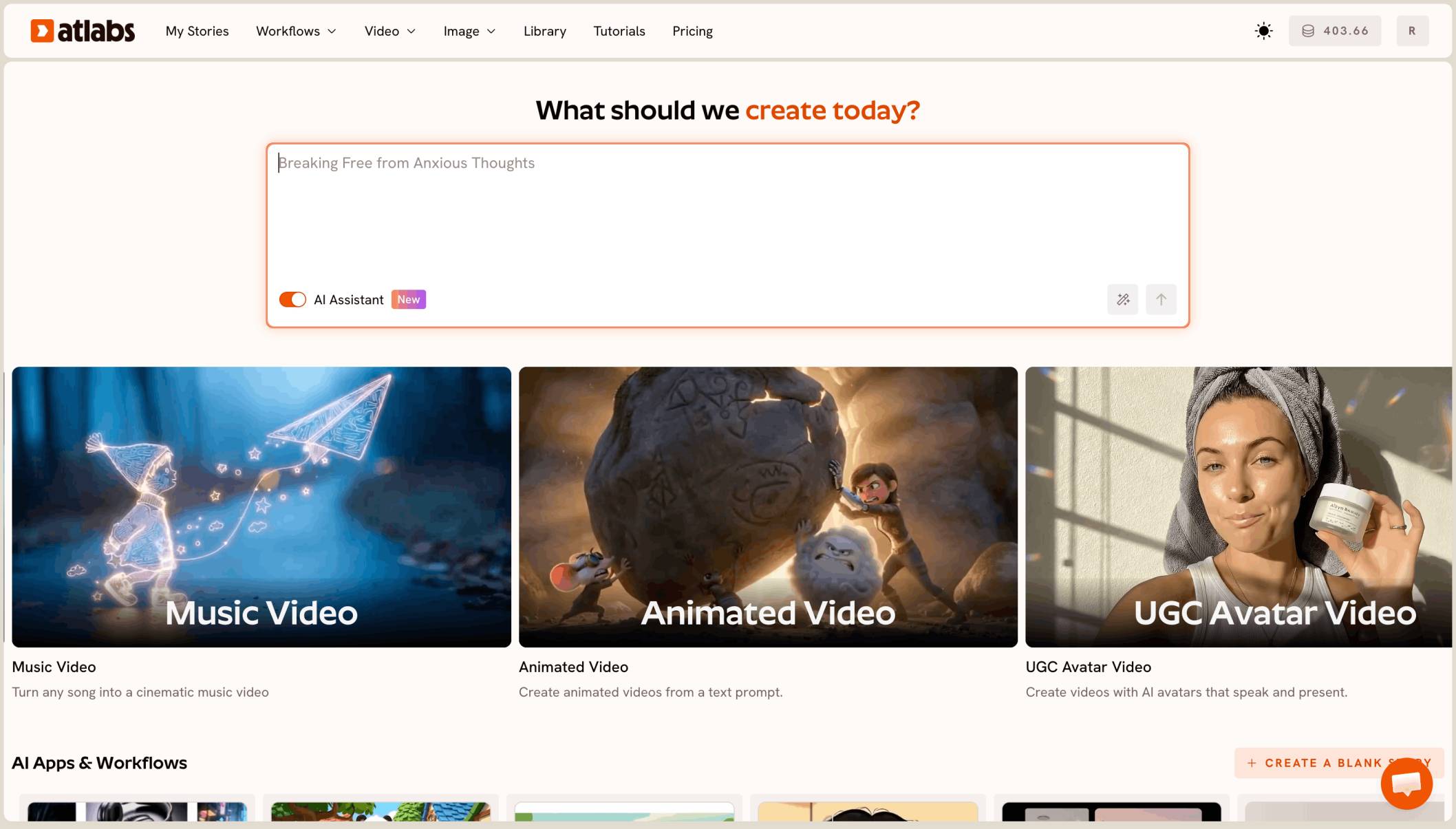
The best alternative to Powtoon for music videos in 2026 is Atlabs. Powtoon was built for animated presentations and explainers, so it cannot read a finished track and build scenes around it. The five tools below all put visuals to music, but they fall into two camps: music first generators that read your audio, and general clip generators that you direct by hand. Here is how they rank for an indie artist with a track ready to go.
Top 5 Powtoon alternatives, ranked
1. Atlabs Best for cinematic music videos generated from a finished track.
2. Neural Frames Best for stem reactive visuals built specifically for musicians.
3. Runway Best for the highest quality cinematic clips, shot by shot.
4. Kaiber Best for abstract loops and Spotify Canvas style visualizers.
5. Pika Best for fast teasers and short social clips.
Why this list matters in 2026
Putting visuals to music in 2026 splits into two approaches. Music first generators read your audio and build the video for you, which is the camp Atlabs and Neural Frames sit in. General clip generators like Runway and Pika, and to a degree Kaiber, produce strong footage that you then direct, time, and assemble by hand. Powtoon belongs to neither camp, since it was built for slide based explainers, which is why indie artists outgrow it the moment they want a real music video. This list ranks all five on how much of the work the tool does for you versus how much you do yourself.
▶ Try the Music Video workflow on Atlabs
Comparison table
Feature | Atlabs | Neural Frames | Runway | Kaiber | Pika |
|---|---|---|---|---|---|
Best for | Videos from a track | Stem reactive videos | Top quality clips | Abstract loops | Fast teasers |
Creation method | Music first, guided | Audio reactive, Autopilot | Prompt to clip | Canvas, manual | Prompt to clip |
Reads your audio | Yes, tempo and mood | Yes, 8 stem | No | BPM via Beat Sync | No |
Character consistency | High, Cast sheets | High, from a reference | Within a clip | Limited | Limited |
Lip sync to vocals | Yes | No | No | No | Image only |
Realistic, live action look | Yes, style library | Skews abstract | Yes, strong | Skews stylized | Mixed |
Starting price | Free tier, Pro about 19 per mo | Free trial, about 26 per mo | Free, Standard about 12 per mo | About 29 per mo, no free | From about 8 per mo |
1. Atlabs – The music first pick
Best For: Indie artists and musicians who want a cinematic music video from a finished track, without filming or editing.
Atlabs takes the top spot because it is built around the one thing Powtoon never did, your audio. You upload a track and the dedicated Music Video workflow reads its tempo, mood, and genre, then generates the scenes for you.
Key Features
Music Video workflow that starts from your track
Upload an mp3 up to 200MB or paste a Suno link, and the platform reads tempo, mood, and genre before generating scenes. Powtoon never read audio at all.
Character consistency through Cast
Define a character once and its reference sheet keeps the same face and wardrobe across every scene, the drift problem that breaks most AI music videos.
Realistic styles and named models
Pick a realistic, live action visual style, with Kling 3.0 for cinematic motion and Google Veo 3.1 for wide establishing shots, all inside one flow.
Director controls and Lip Sync
Choose from six generated concepts or describe your own, switch between Narrative and Performance, and sync mouth movement to your vocal take with Lip Sync.
Idea for a kids science explainer: a curious child and a friendly robot explore how rainbows form, bright 3D Cartoon style, warm lighting, simple backgrounds, gentle camera moves, 16:9.
→ Try this in Atlabs Animated Video workflow
Pricing
Free tier available to test the Animated Video workflow
Pro: about 19 dollars per month, billed annually
Verdict: If you want a cohesive story with consistent characters rather than a set of disconnected clips, Atlabs is the strongest pick. The trade off is a guided, generative flow, so a manual editor gives you more frame level control if that is what you need.
▶ Start free on Atlabs
2. Neural Frames – The musician's stem reactive tool
Best For: Producers and electronic artists who want visuals that react to the individual parts of their mix.
Built in Berlin specifically for independent musicians, Neural Frames is the most music specific tool here besides Atlabs. It reads your track at the stem level and reacts to what is actually happening in the mix, which makes it a serious option for artists who want technical control over the reactivity.
Key Features
8 stem audio reactivity
Splits your track into eight stems, covering vocals, drums, bass, melody, and more, then maps each one to visual triggers like color shifts and scene cuts.
Autopilot mode
Reads your lyrics and tempo, drafts scenes, and produces a full video in about ten minutes, with lyric video support for timestamped files.
Character consistency and 4K
Holds a character from a single reference image and exports up to 4K, including full three to five minute videos for YouTube and streaming.
Pricing
Free trial: 50 credits, no card required
Neural Knight: about 26 dollars per month
Neural Ninja: about 66 dollars per month
Neural Nirvana: about 199 dollars per month
Verdict: Pick Neural Frames when precise, stem level audio reactivity is the heart of the piece. The trade offs are a steep frame by frame learning curve, an aesthetic that skews abstract, and no lip sync.
3. Runway – The cinematic quality leader
Best For: Filmmakers and creators who want the highest clip quality and are comfortable editing.
Runway, now on its Gen-4 and Gen-4.5 models, produces some of the highest fidelity clips available, which is why many filmmakers reach for it first. The catch for musicians is that it has no music specific features, so the music aware part of the workflow is on you.
Key Features
Gen-4 and Gen-4.5 quality
Among the most cinematic output on the market, with sophisticated motion control that professional creators rely on.
Image to video and Act One
Animate a still or drive a facial performance, in 16:9, 9:16, or 1:1, in five to ten second clips you extend and stitch together.
New Audio tab
Generates basic sound effects and ambient beds, though it does not analyse your track tempo or sync visuals to a beat.
Pricing
Free: 125 one time credits
Standard: about 12 dollars per month billed annually, or 15 monthly
Pro: about 35 dollars per month
Verdict: Pick Runway when raw clip quality matters more than a music aware workflow and you are happy to plan shots, time cuts by hand, and assemble in an editor.
4. Kaiber – The visualizer specialist
Best For: Electronic, ambient, and experimental artists making looping visualizers.
Kaiber helped define AI music visuals and its work appeared in Linkin Park's Lost visual, so it carries real credibility with musicians. It is at its best for short looping content rather than full narrative videos.
Key Features
Beat Sync
Reads a detected BPM and aligns transitions to it, with low setup friction for looping visualizers.
Superstudio canvas
An infinite, node based workspace that routes through several models including Luma, Veo, Kling, Runway, and Flux.
Distinct stylized output
A recognisable character for ambient, psych, and experimental electronic that is hard to copy elsewhere.
Pricing
No free plan
Entry: about 29 dollars per month
Verdict: Pick Kaiber for abstract loops and Spotify Canvas style clips, not narrative videos. Assembling a full track is manual, there is no song section awareness, and characters drift between clips.
5. Pika – The fast teaser maker
Best For: Musicians who need quick teasers and short social clips.
Pika, built by Pika Labs, is fast and playful, strong at short clips and creative effects. For a full music video it falls short, but for a punchy social hook you can turn around in minutes it is a useful tool.
Key Features
Fast short clips
Three to ten second generations that are quick to iterate, with image to video and lip sync on a static image.
Pika effects
Specialised tools like Pikaframes, Pikaswaps, and Pikaffects for morphs, swaps, and stylised motion.
Up to 4K and Firefly
Higher resolutions on upper plans and an Adobe Firefly partnership, though audio does not drive the visuals.
Pricing
Limited free tier
Paid: from about 8 dollars per month
Verdict: Pick Pika for a punchy teaser or looping social clip, not a complete music video. Clips are short and any sync to your track is manual post production.
Final verdict
For specific needs, each tool earns its place: Neural Frames for stem level reactivity, Runway for raw clip quality, Kaiber for looping visualizers, and Pika for fast teasers. But if you are an indie artist who wants a cohesive, story driven music video from a finished track, without filming or hours of editing, Atlabs is the clear pick for 2026. It is the only tool here that combines audio driven scene generation, character consistency, realistic styles, and Lip Sync in one workflow.
▶ Create your music video on Atlabs
References and data sources
Feature and pricing data verified as of mid 2026.
Atlabs
Verified via the Atlabs pricing page and Music Video workflow. Free tier available, Pro about 19 dollars per month billed annually.
Neural Frames
Verified via Neural Frames and independent 2026 reviews. 50 credit free trial, paid tiers about 26 to 199 dollars per month, 8 stem analysis and Autopilot confirmed.
Runway
Verified via Runway's official pricing page, April 2026. Free tier with 125 one time credits, Standard about 12 dollars per month annually, Pro about 35 dollars per month.
Kaiber
Verified via Kaiber and independent reviews, 2026. No free plan, entry about 29 dollars per month, Superstudio and Beat Sync confirmed.
Pika
Verified via Pika Labs and 2026 reviews. Paid from about 8 dollars per month, up to 4K on higher plans, Adobe Firefly integration confirmed.
Pricing is accurate as of mid 2026 and changes over time. Check each tool's official site before buying.
FAQ
What is the best free tool for music videos in 2026?
Atlabs offers a free tier so you can run a track through the Music Video workflow before paying. Runway and Pika also have limited free options, and Neural Frames gives you a 50 credit free trial with no card.
Can you make a music video in Powtoon?
You can put visuals to audio in Powtoon, but it is built for animated presentations, explainers, and training content. It does not read your track tempo or mood, so the result looks like an animated slide deck rather than a video timed to your song.
Which Powtoon alternative is best for indie musicians?
Atlabs is the best fit because its Music Video workflow starts from your uploaded track and generates scenes from the tempo, mood, and genre. Neural Frames is a strong second for stem reactive control.
Do I need editing skills to make an AI music video?
Not with a music first tool. Atlabs and Neural Frames both generate the scenes for you, so you skip manual cutting. Runway, Kaiber, and Pika give you clips that you usually assemble and time yourself.
Which tool keeps characters consistent across scenes?
Atlabs uses Cast reference sheets to hold the same character across every scene, and Neural Frames can hold a character from a single reference image. Runway, Kaiber, and Pika tend to drift between separate clips.
Get started
Upload a track, pick a realistic style, and let the Music Video workflow build the scenes around your audio.
Open Atlabs