
You type your first Seedance 2.0 prompt. You hit generate. The result looks like a fever dream shot by a robot.
The subject morphs. The camera does something you never asked for. The lighting feels wrong. You try again. Same result.
This is not a Seedance 2.0 problem. This is a prompting problem.
Seedance 2.0 is one of the most powerful AI video generation models available right now. It handles realistic physics, frame-to-frame character consistency, native audio generation, and understands professional cinematography vocabulary better than any model before it. But it is only as good as the instructions you give it.
This guide covers the exact prompt architecture that actually works, the camera and lighting vocabulary Seedance 2.0 responds to, and how to run your entire Seedance 2.0 workflow inside Atlabs so every scene you generate is production-ready.
This guide is for content creators, marketers, filmmakers, and social video producers who want cinematic Seedance 2.0 output without trial-and-error frustration.
What Makes Seedance 2.0 Different
Before getting into prompts, you need to understand what Seedance 2.0 is actually good at, because that shapes how you write for it.
Seedance 2.0 from ByteDance is built for realistic motion and temporal consistency. Unlike some other AI video models that treat each frame as a separate image generation task, Seedance 2.0 reasons about motion across time. That is why it handles things like:
Water splashing with accurate physics
Hair and fabric movement that follows the body
Faces that hold their structure across a full 10 second clip
Camera movements that feel like a real operator made them
Native audio generation tied to the visual scene
What it needs from you is directorial clarity. Vague prompts hand control over to chance. Specific prompts hand control to you.
The Seedance 2.0 Prompt Formula
Every high-performing Seedance 2.0 prompt follows the same structure. Think of yourself as a director handing a shot breakdown to your DP.
Subject
Who or what is in the frame. Be as specific as a casting director.
Weak: A woman
Strong: A woman in her late 20s with shoulder-length dark brown hair, wearing an oversized cream linen shirt, standing barefoot on a tiled kitchen floor in soft morning light
The more specific the subject description, the more consistent Seedance 2.0 will be across regenerations. Vague subjects morph. Specific subjects hold.
Action
What is happening in the scene. Use present tense with active, physical verbs. Specify speed and direction.
Weak: She's dancing
Strong: She slowly turns around, arms rising, fabric swaying gently at her sides, her weight shifting from heel to toe
Seedance 2.0 prompting principle: describe motion as continuous, natural, and gradual. Words like slowly, gently, softly, and lightly outperform high-energy descriptors for realistic output. Avoid asking for multiple complex simultaneous actions.
Scene and Environment
Where is this happening. Time of day, weather, location type, and background detail all shape what Seedance 2.0 generates.
A minimalist Japanese apartment at dusk, tatami floor, sliding paper screens partially open to a balcony, city glow just visible through the gap
Lighting
Lighting is one of the highest-leverage elements in Seedance 2.0 prompting. The model responds powerfully to specific lighting vocabulary.
Golden hour: warm amber light at a low angle, long shadows
Blue hour: soft diffused cool light, deep shadows, romantic atmosphere
High contrast: strong key light from one direction, deep shadow areas
Overcast: diffused flatlight, no hard shadows, desaturated tones
Neon: colored light spill, wet surface reflections, urban night
Candlelight: warm flickering glow, intimate and close
Studio: controlled three-point lighting, clean commercial feel
Camera Language
This is where most creators leave performance on the table. Seedance 2.0 understands professional cinematography terms natively. Use them.
Shot types:
Extreme close-up (ECU): face, product detail, eyes
Close-up (CU): head and shoulders, product hero shot
Medium shot (MS): waist up, conversational feel
Wide shot (WS): establishing context, full environment
POV: first-person perspective, immersive
Camera movements:
Slow dolly in: subtle push toward subject, builds tension or intimacy
Dolly out: reveals context, emotional distance
Tracking shot: follows the subject sideways, fluid and cinematic
Handheld: slight sway and micro-shake, documentary or UGC feel
Orbit / arc: camera circles the subject, works for product reveals
Crane up: elevating perspective, grand or aspirational
Drone / aerial push forward: landscape, establishing, epic scale
Visual Style
Style keywords anchor the aesthetic. Single references work. Stacked references create distinctive hybrid results.
Cinematic, film grain, Hollywood blockbuster: movie-quality output
Documentary-style, raw footage: authentic and realistic feel
Wes Anderson symmetry: flat plane compositions, pastel palette
Blade Runner neon noir: high contrast, teal and orange, rain
National Geographic: natural world, clean and authoritative
Golden hour lifestyle: warm, aspirational, social-native
8K photorealistic, hyper-detailed: maximum visual quality mode
Quality Constraints
Weld these to the end of every prompt like a safety net:
4K, ultra-high definition, rich details, clear sharpness, cinematic texture, natural colors, soft lighting, no blur, no ghosting, no flicker, stable picture
Negative Constraints
Telling Seedance 2.0 what not to do is as powerful as telling it what to do.
Clear facial features, stable face, no distortion, no deformation, consistent clothing, unchanged hairstyle, normal human body structure, movement natural and smooth
The Master Prompt Template
Here is the full Seedance 2.0 prompt framework assembled:
[Subject description with specific appearance and clothing]. [Action with speed, direction, and secondary motion details]. [Scene: location, time of day, weather]. [Lighting: type, direction, quality]. [Camera: shot type + movement]. [Visual style references]. [Quality tags]. [Negative constraints].
Every great Seedance 2.0 clip can be built from this formula. The sections below show it applied to real use cases.

Prompt Examples by Use Case
Use Case 1: Product Ad (Beauty / Skincare)
Goal: A premium-feeling hero shot for a serum or moisturiser campaign.
Close-up of a glass serum bottle on a white marble surface. A single drop slowly forms at the dropper tip and falls in slow motion, hitting the marble and spreading outward in perfect ripple rings. Studio lighting with a soft overhead key and subtle rim light catching the glass edges. Camera holds still, macro lens, shallow depth of field. Ultra premium commercial aesthetic, clean and minimal, Glossier brand energy. 4K, ultra-high definition, no blur, stable picture, no ghosting, no product distortion.
Atlabs tip: When using Seedance 2.0 inside Atlabs for product ads, upload your product image as a reference and tag it @ProductName to anchor the model to your exact SKU. This eliminates the morphing problem common with product generation.
Use Case 2: Lifestyle and Fashion
Goal: An authentic-feeling social video for a clothing brand.
A woman in her late 20s with dark wavy hair, wearing a relaxed tan linen blazer over a white fitted top and straight-leg jeans, walks slowly through a sun-drenched European side street. Midday light filtering between buildings creates alternating bands of warm shadow and golden highlight. Handheld tracking shot from the side, staying at hip level, slight natural sway. Warm lifestyle aesthetic, film grain, Aritzia campaign energy. 4K cinematic, stable face, no distortion, consistent outfit across frames.
Use Case 3: Cinematic Narrative / Storytelling
Goal: A dramatic story-driven scene with emotional weight.
Extreme close-up of a woman's face. Her eyes open slowly. Neon city lights are reflected in her irises. A single tear forms at the corner of her eye, catching the light as it rolls down her cheek. Shallow depth of field, bokeh city background. Slow dolly in from medium to close as the tear falls. Blade Runner cinematography style, warm amber and cool blue contrast, film grain. Intimate and emotionally charged. 4K, ultra-high definition, stable face structure, no facial distortion, clear details.
Use Case 4: Social UGC / Creator Content
Goal: An authentic-looking phone-shot creator clip.
A creator in her mid-20s, casual light-wash jeans and a white tank top, sits cross-legged on a beige couch in a bright apartment. She looks directly at camera, animated and conversational, gesturing with both hands while talking. Handheld phone perspective, slight natural sway, eye-level framing. Warm indoor window light from the right. Ungraded, natural Instagram aesthetic, real and unpolished feel. No captions, hands stay natural, 10 seconds total, simple background. Stable face, consistent clothing, no distortion.
Use Case 5: Anime / Illustration Style
Goal: A Makoto Shinkai-style atmospheric scene.
A teenage girl in a high school uniform stands on a rooftop at magic hour, her hair blowing gently in the wind. The sky behind her is a gradient of deep orange to purple. Cherry blossom petals drift past slowly. She looks toward the horizon with a quiet, contemplative expression. Wide shot slowly narrowing to medium. Makoto Shinkai animation style, ultra-detailed background art, soft rim lighting, warm and melancholic color palette, cinematic grain. No dialogue, no text, stable character proportions, consistent face, no body distortion.
Use Case 6: Commercial Architecture / Real Estate
Goal: A premium walkthrough-style reveal for a luxury property.
A slow forward crane shot descending from above a modern villa at golden hour. The camera moves through an open glass facade into an open-plan living space with floor-to-ceiling windows. Warm interior light mixes with the amber dusk outside. The space is minimal and architectural. Dolly forward through the room, ending on the view through the far window. Luxury real estate aesthetic, Architectural Digest photography style. 4K cinematic, stable environment, no flickering, no motion blur on architecture.
Advanced Techniques
Reference Stacking for Unique Styles
Using a single style reference gives you something recognizable. Stacking two or three creates something original that belongs only to you.
Studio Ghibli color palette + Christopher Nolan cinematography + Wes Anderson symmetrical framing
The model synthesizes these into a hybrid that does not simply copy any one of the source references. This is one of the most reliable techniques for creators who want a distinctive visual signature.
Multi-Shot Sequencing
Seedance 2.0 generates individual clips of 5 to 15 seconds. For narrative content, think in shots, not scenes. Plan your sequence before you start generating.
Shot 1 (0 to 5s): Establish the environment. No subject yet. Let the space breathe.
Shot 2 (5 to 10s): Introduce the subject in motion.
Shot 3 (10 to 15s): Close in on emotion, detail, or product.
Inside Atlabs, you can chain these clips in sequence inside the same project workspace, keeping your visual style locked across every shot without re-entering your full prompt each time.
Using Reference Images with @Tagging
Seedance 2.0 supports multimodal input. When you have a reference image for a character, product, or environment, upload it and reference it in your prompt with @tagging:
@Character1 stands in the kitchen, looking out the window. Camera slowly pushes in over her shoulder. Golden morning light.
The @reference locks Seedance 2.0 to the uploaded visual, which significantly reduces character drift across multiple shots. This is especially valuable for product ads where SKU accuracy matters, and for narrative series where your character needs to look the same in episode three as they did in episode one.
Controlling Duration and Pacing
Shorter clips require you to commit to one clear moment. Longer clips have room for a simple arc: set, develop, resolve.
5 seconds: a single emotional beat or product detail
10 seconds: a subject enters and reacts, or a product reveals
15 seconds: a micro-narrative with beginning, middle, and end
Do not try to tell a three-act story in one clip. Focus on one moment, one emotion, one movement.
What Seedance 2.0 Does Not Like
Knowing the failure modes saves you credits and time.
Too many simultaneous actions: pick one primary motion per clip
Contradictory instructions: do not ask for handheld and locked tripod in the same prompt
Abstract concepts without physical anchoring: describe what is visible, not what is felt
Crowd scenes with complex multi-person interaction: Seedance 2.0 handles one or two subjects well, not a crowd
Rapid cuts within a single generation: each clip is one continuous shot
Running Your Seedance 2.0 Workflow Inside Atlabs
Knowing how to write Seedance 2.0 prompts is one half of the equation. The other half is where you run them.
Most creators hit a ceiling because they are stitching together three or four separate tools: a prompt builder, an AI model interface, a video editor, and a caption tool. Every handoff is a creative tax.
Atlabs is built around removing those handoffs entirely.
What the Atlabs Workflow Looks Like
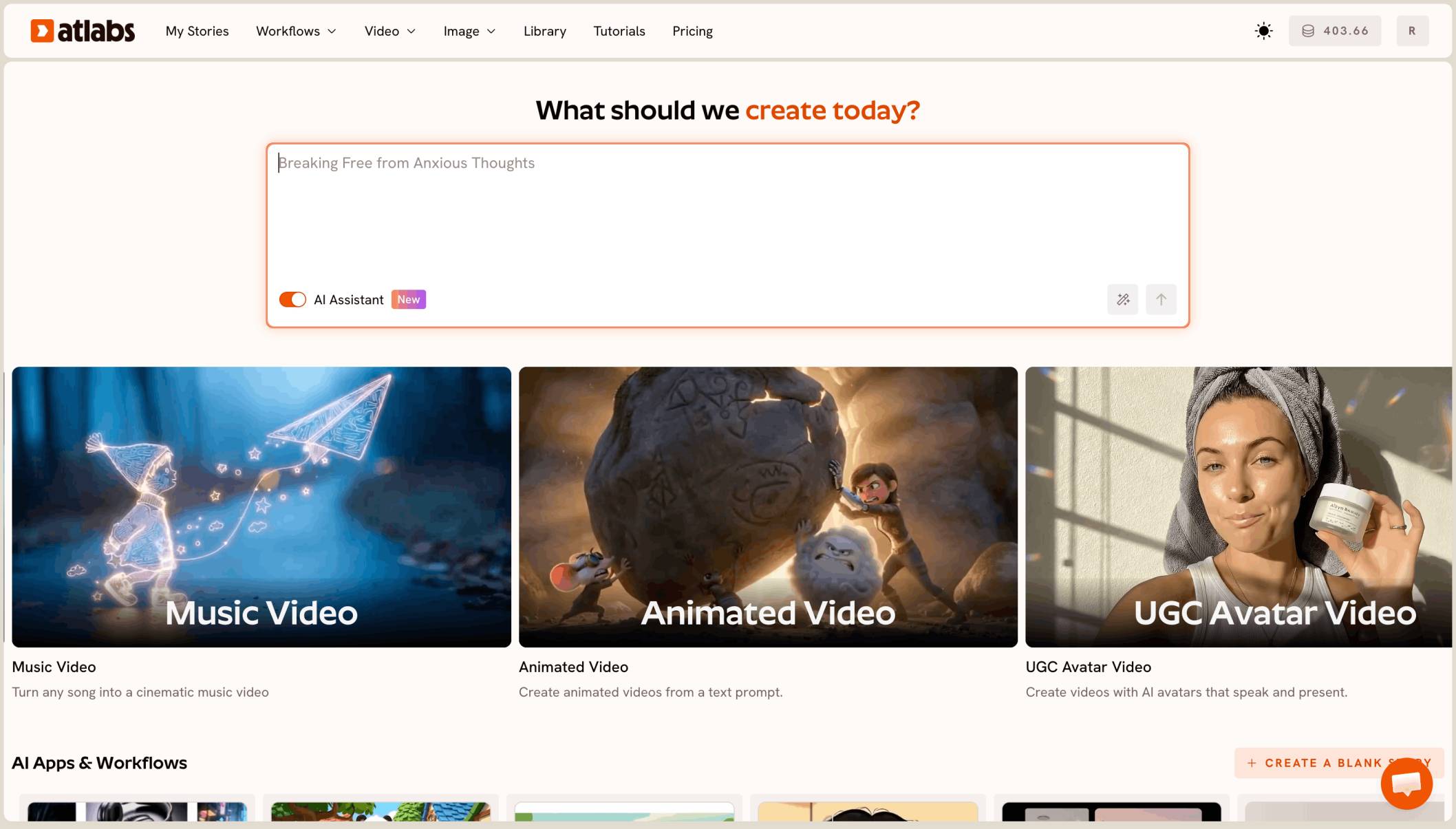
Step 1: Open the AI Motion tool inside Atlabs and select Seedance 2.0 as your generation model.
Step 2: Upload your reference images and tag them with @ProductName or @CharacterName directly in the prompt interface.
Step 3: Write your prompt using the framework from this guide. Atlabs does not limit prompt length, so you can go as detailed as you need.
Step 4: Generate. Review. If a shot needs a tweak, regenerate that individual clip without disturbing the rest of your sequence.
Step 5: Move directly into the Atlabs editor. Add AI-generated captions, drop in background music from the royalty-free library, reframe for 9:16 vertical if you are publishing to Reels or TikTok, and export.
Atlabs supports Seedance 2.0, Veo 3, Kling, and other leading models in the same workspace. You can compare outputs across models for the same prompt without switching platforms.
Who Uses This Workflow
The Atlabs plus Seedance 2.0 combination is used by:
E-commerce brands producing product ad creatives at scale
Social media agencies generating client video content faster
Independent filmmakers building short-form narrative series
Course creators and educators building animated lesson content
Music video directors sketching scene ideas before production
The unifying thread is that all of these creators need cinematic quality output on a production schedule that does not have room for a full crew.
Quick Reference: Seedance 2.0 Prompt Checklist
Before you hit generate, run this check:
Subject is described with specific appearance, clothing, and age
Action uses present tense with direction and speed
Environment includes location, time of day, and atmospheric detail
Lighting is specified with type and direction
Camera shot type is defined
Camera movement is defined
Visual style references are included
Quality tags are included at the end
Negative constraints address face stability, outfit consistency, and no distortion
Prompt focuses on one clear moment, not multiple simultaneous events
Every one of these elements in place: cinematic output. Any one missing: degraded consistency.
Start Creating with Seedance 2.0 on Atlabs
Seedance 2.0 is one of the most capable AI video models available to creators today. The gap between a generic clip and a cinematic one is not the model. It is the prompt.
You now have the formula, the vocabulary, the use-case examples, and the checklist. The only thing left is to put it into practice.
Atlabs gives you direct access to Seedance 2.0 inside a full production workspace, with reference image support, built-in editing, captions, music, and multi-format export. No stitching tools together. No jumping between platforms.
Try Seedance 2.0 free on Atlabs >> atlabs.ai
Start with one of the prompt templates from this guide. Upload a reference image. Generate your first shot. Then build from there.
The cinematic AI video era is not something you watch. It is something you make.